What Is SIPC Insurance? How It's Different From FDIC (and What It Doesn't Cover)
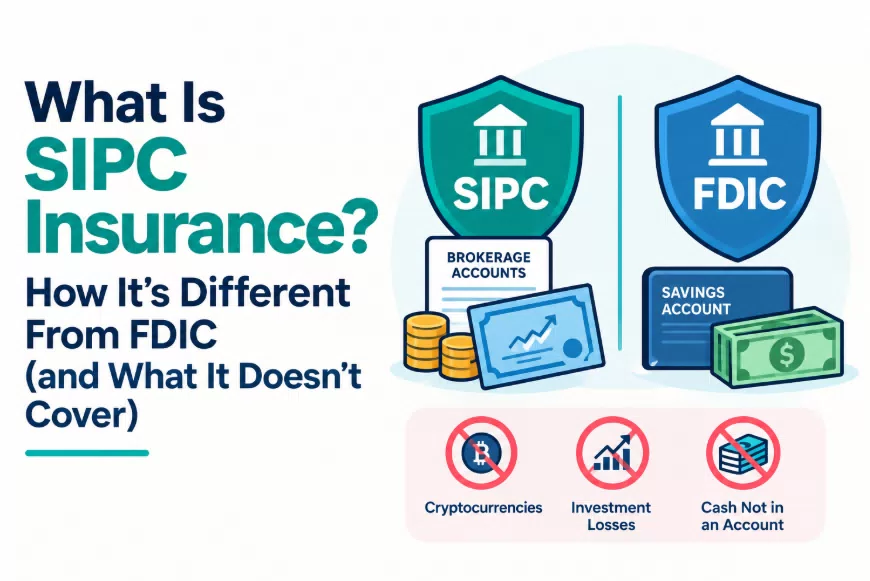
SIPC — the Securities Investor Protection Corporation — protects customers if their brokerage firm fails and customer property goes missing. It's frequently described as "the FDIC for brokerage accounts," which captures the general idea but obscures the one distinction that actually matters: SIPC does not protect against investment losses of any kind. A stock dropping 80% is not a SIPC event. Understanding exactly what SIPC does and doesn't cover is worth more than the coverage numbers themselves.
What SIPC Actually Protects Against
Per SIPC's own description, SIPC steps in when a SIPC-member brokerage firm fails and customer securities or cash go missing from customer accounts — most customers of a failed brokerage are protected in that specific scenario. It's protection against custodial failure: the firm holding your assets collapsing and those assets not being where they're supposed to be. It is not protection against the assets themselves losing value.
SIPC covers securities like stocks, bonds, mutual funds, ETFs, Treasury securities, and CDs, along with cash held in connection with buying or selling those securities, when held at a SIPC-member firm.
What SIPC Explicitly Does Not Cover
SIPC's own website is direct about this, and it's worth quoting the core exclusions precisely:
Declines in the value of your securities — if your portfolio drops in value because the market moved against you, SIPC does nothing
Worthless stocks or other securities you were sold, if the investments themselves were legitimate securities that simply failed
Losses from bad investment advice — a broker recommending an unsuitable or poorly performing investment isn't a SIPC-covered event
Commodity futures contracts (with limited exceptions) and certain unregistered investment contracts
Currency, and most cryptocurrency holdings — coverage for crypto and similar digital assets is inconsistent and not uniformly guaranteed across situations
SIPC was never designed to be a hedge against market risk. Investments fluctuate in value by nature, and that fluctuation — however large — has nothing to do with what SIPC exists to fix.
The Coverage Limits
SIPC protects up to $500,000 per customer, which includes a $250,000 sub-limit specifically for cash claims within that total. The cash sub-limit isn't an additional $250,000 on top of the $500,000 — it's a cap carved out of the same overall limit.
A Worked Example: Cash Under the Sub-Limit
Say your brokerage account holds $580,000 in securities and $70,000 in cash, and the firm fails with customer property missing.
Since the $70,000 cash is under the $250,000 sub-limit, it's covered in full. That leaves $430,000 of remaining room under the overall $500,000 limit for the securities portion:
Cash covered: $70,000 (fully, since it's under the sub-limit)
Securities covered: $430,000 (the remaining room under the $500,000 cap)
Total covered: $500,000
Uncovered shortfall: $650,000 − $500,000 = $150,000
A Worked Example: Cash Exceeding the Sub-Limit
Now say the same $600,000 account instead holds $200,000 in securities and $400,000 in cash.
Here the cash sub-limit actually binds: even though the overall limit is $500,000, cash coverage is capped at $250,000 regardless of how much room is technically left in the total.
Cash covered: $250,000 (capped at the sub-limit, even though $400,000 was held)
Securities covered: $200,000
Total covered: $450,000
Uncovered shortfall: $600,000 − $450,000 = $150,000
Notice this account had a lower total balance than the first example ($600,000 vs. $650,000) but ended up with a larger proportional shortfall relative to what was actually protected — purely because more of it was sitting in uninvested cash rather than securities. This is precisely why holding a large uninvested cash balance at a brokerage, rather than in an FDIC-insured deposit account, carries a specific and often-overlooked coverage gap.
The "Separate Capacity" Rule Multiplies Your Protection
Here's a detail that surprises people in a positive direction, for once: the $500,000 limit applies per separate capacity, not as one blanket cap per person at a brokerage. SIPC recognizes distinct capacities including individual accounts, joint accounts, traditional IRAs, Roth IRAs, trust accounts, and corporate accounts — and accounts held in different capacities at the same firm each get their own $500,000 envelope, even though accounts held in the same capacity get combined.
An Example
Say one investor holds three accounts at the same brokerage firm: a personal individual account, a Roth IRA, and a joint account shared with a spouse. Because these are three distinct capacities:
Individual account: up to $500,000 in protection
Roth IRA: up to $500,000 in protection (a separate capacity from the individual account)
Joint account: up to $500,000 in protection (a separate capacity from both of the above)
Total potential SIPC protection at this single brokerage firm: $1,500,000
This only applies across genuinely different capacities, though — holding two separate individual brokerage accounts at the same firm doesn't double your coverage, since both fall under the same "individual" capacity and get combined into a single $500,000 limit.
SIPC vs. FDIC: Two Different Jobs Entirely
FDIC | SIPC | |
|---|---|---|
Protects | Bank deposit accounts | Brokerage securities and cash |
Triggered by | Bank failure | Brokerage firm failure with missing assets |
Standard limit | $250,000 per depositor, per bank, per ownership category | $500,000 per customer, per separate capacity ($250,000 cash sub-limit) |
Covers market losses? | Not applicable — deposits don't fluctuate in value | No |
Governing body | Federal Deposit Insurance Corporation (federal agency) | Securities Investor Protection Corporation (nonprofit created by federal statute) |
A checking or savings account is an FDIC matter. A brokerage account holding stocks, bonds, or funds is a SIPC matter. Many people interact with both without realizing it — a bank-held CD is FDIC territory; a Treasury bond purchased through a brokerage is SIPC territory, even though both are relatively safe, boring investments.
Excess SIPC Coverage
Some brokerage firms voluntarily purchase additional private insurance — often called "excess SIPC" coverage — that extends protection beyond the standard $500,000/$250,000 limits for customers with larger account balances. This isn't a government program; it's a private arrangement specific to individual firms, so the existence and size of any excess coverage varies by brokerage and is worth checking directly with your specific firm rather than assumed.
Frequently Asked Questions
Does SIPC protect me if my stocks crash in value?
No, under any circumstances. SIPC exists solely to address missing customer property after a brokerage firm's failure — a decline in the market value of legitimately held securities is not a SIPC event, regardless of how large the loss.
If I have $700,000 at one brokerage, is $200,000 automatically uninsured?
Not necessarily in the way an FDIC excess deposit would be. SIPC's role is recovering missing customer property after a firm failure — if your securities are properly held and accounted for, the $500,000 figure is the maximum SIPC would advance toward any shortfall, not an automatic guarantee that exactly $200,000 is unprotected. Actual risk depends on the specific circumstances of the failure.
Does SIPC cover cryptocurrency held at a brokerage?
Coverage for crypto and similar digital assets is inconsistent and not uniformly guaranteed — it depends heavily on how the specific asset is classified and held, making it a meaningfully different situation from traditional securities like stocks and bonds.
Are all brokerage firms SIPC members?
Most registered broker-dealers are required to be SIPC members, but it's still worth confirming a specific firm's membership status directly, since protection only applies at member firms.
How do I make a claim if my brokerage fails?
SIPC claims generally need to be filed within a specific window (commonly cited around 60 days) after a firm's liquidation begins, and the process is managed through a court-appointed trustee — the strict deadline is a detail worth knowing rather than assuming there's unlimited time to file.
Key Takeaways
SIPC protects brokerage customers when a member firm fails and customer securities or cash go missing — up to $500,000 per customer per separate capacity, with a $250,000 sub-limit specifically for cash. It categorically does not protect against investment losses, bad advice, or securities that simply decline in value, which remains the single most common and consequential misunderstanding about the program.
The "separate capacity" rule can meaningfully multiply your real protection if you hold accounts of genuinely different types at the same firm, while the cash sub-limit can create a real coverage gap — as the worked examples above show — for anyone holding a large uninvested cash balance at a brokerage rather than moving it to an FDIC-insured deposit account.
Sources
This article is for general educational purposes only and does not constitute financial, investment, tax, or legal advice.