What Is ROI (Return on Investment)? Definition, Formula & Examples
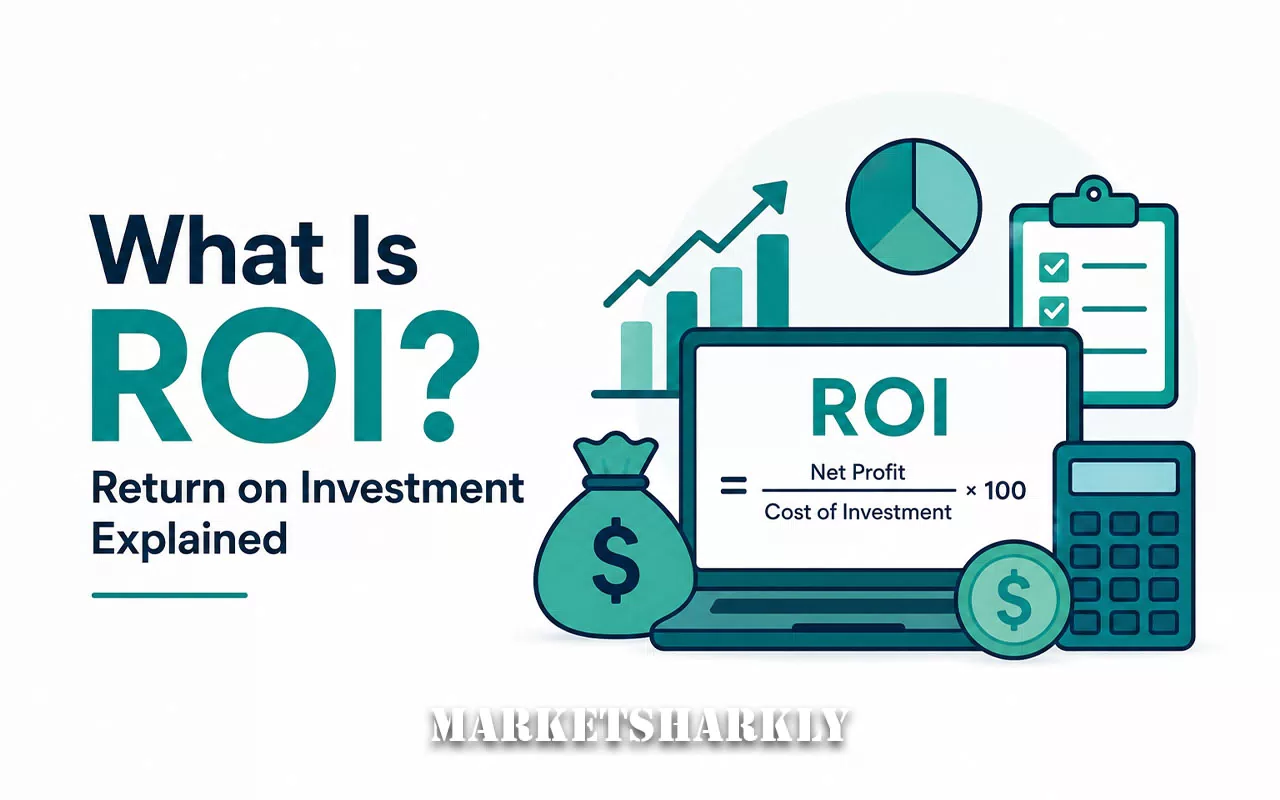
ROI, short for return on investment, is one of the simplest and most widely used ways to measure how well an investment performed. It compares what you gained against what you put in, expressed as a single percentage — which is exactly what makes it so easy to use, and also where its limitations start.
The ROI Formula
The basic formula is:
ROI = (Net Profit ÷ Cost of Investment) × 100
Where net profit is whatever you gained from the investment minus what you originally put in. If an investment cost you $1,000 and it's now worth $1,200, your net profit is $200, and your ROI is:
($200 ÷ $1,000) × 100 = 20%
That's the entire calculation. ROI doesn't require anything beyond a starting cost and an ending value — which is exactly why it's used so widely across such different contexts, from a single stock purchase to a small business marketing budget.
A Worked Example: Investing in a Stock
Say you buy $5,000 worth of a stock. Over the holding period, it pays out $150 in dividends, and by the time you sell (or check its current value), the position is worth $6,200.
Net profit: ($6,200 + $150) − $5,000 = $1,350
ROI: ($1,350 ÷ $5,000) × 100 = 27%
Notice that dividends count as part of the return here, not just the change in share price. Leaving out cash flows like dividends, interest, or rental income would understate the real ROI of an investment that generates them.
A Worked Example: Real Estate, With Costs Included
ROI gets more useful — and more revealing — once you factor in every cost involved, not just the purchase price.
Say you buy a rental property for $250,000, pay $8,000 in closing costs, and spend $15,000 on renovations before selling it later for $320,000, paying $12,000 in selling costs along the way.
Total cost of the investment: $250,000 + $8,000 + $15,000 = $273,000
Net profit: $320,000 − $12,000 − $273,000 = $35,000
ROI: ($35,000 ÷ $273,000) × 100 ≈ 12.8%
If you'd only compared the $320,000 sale price against the $250,000 purchase price and ignored the other $35,000 in costs, you'd have calculated a very different — and inflated — ROI of nearly 28%. This is the most common way ROI gets miscalculated in practice: leaving out fees, closing costs, renovation spending, taxes, or other costs that were genuinely part of what the investment required.
What ROI Doesn't Tell You
ROI's biggest limitation is built into the formula itself: it says nothing about time.
A 50% ROI sounds identical whether it happened over one year or five years, but those are very different outcomes. Turning $10,000 into $15,000 in a single year is a dramatically better result than taking five years to do the same thing, even though the plain ROI figure — 50% — is exactly the same in both cases. Converting that same 50% return into an annualized figure makes the difference obvious: the one-year version stays at a 50% annual rate, while the five-year version works out to roughly 8.5% per year once you account for the time it took to get there.
Because of this, ROI on its own is best used to compare investments held over similar time periods. Comparing a stock you held for six months against a rental property you held for ten years, using plain ROI for both, isn't really an apples-to-apples comparison. (The standard way to adjust for this — converting a total return into a consistent annual rate — is its own concept, generally referred to as CAGR, and it deserves its own explanation.)
ROI also doesn't account for risk. Two investments with an identical ROI aren't necessarily equally good choices if one carried substantially more risk of loss than the other to get there.
ROI Isn't Just for Stocks and Real Estate
The formula is generic enough to apply to nearly any expenditure with a measurable outcome, which is part of why it shows up so often outside of pure investing. A business might calculate the ROI of an advertising campaign by comparing the revenue it generated against what it cost to run. A homeowner might calculate the ROI of a kitchen renovation by comparing the increase in home value against what the renovation cost. The mechanics don't change — cost in, benefit out, expressed as a percentage — even though the underlying "investment" isn't a financial security at all.
Common Mistakes When Calculating ROI
Leaving out fees and costs. Purchase costs, ongoing fees, transaction costs, and taxes are all part of what an investment actually required, and skipping them inflates the ROI figure.
Ignoring cash flows along the way. Dividends, interest, and rental income are part of the return, not separate from it.
Comparing ROI across very different time periods without adjusting for it. A higher plain ROI over a much longer holding period can still represent a lower annual rate of return than a lower ROI achieved much faster.
Using ROI as the only factor in a decision. It measures historical or projected profitability, not risk, liquidity, or how easily the investment can be sold if circumstances change.
Frequently Asked Questions
Is a higher ROI always better?
Generally more profitable, yes — but only when comparing investments over similar time periods and similar risk levels. A high ROI achieved over a much longer period, or with much higher risk, isn't automatically the better choice.
Does ROI account for inflation?
No. A plain ROI calculation doesn't adjust for inflation, so a positive nominal ROI can still represent a loss in real purchasing power if inflation outpaced the return over the same period.
What counts as "cost" in the ROI formula?
Everything genuinely required to make and exit the investment — the purchase price, plus fees, commissions, closing costs, taxes, or improvement costs, depending on the type of investment.
Can ROI be negative?
Yes. If the investment's net profit is negative — meaning you got back less than you put in, including any costs — the ROI will be a negative percentage, representing a loss.
What's the difference between ROI and CAGR?
ROI measures total return over the entire holding period, however long that was. CAGR (compound annual growth rate) converts that total return into a single consistent annual rate, which makes it possible to fairly compare investments held for different lengths of time.
Key Takeaways
ROI is a straightforward ratio — net profit divided by cost, expressed as a percentage — and its simplicity is exactly what makes it so widely used across investing, real estate, and business decisions alike.
That same simplicity is also its limitation: ROI says nothing about how long it took to earn that return, nothing about the risk involved, and it's only as accurate as the costs and cash flows you actually include in the calculation. Used carefully — with all real costs counted and with time periods compared fairly — it's a useful first checkpoint. Used carelessly, it can make a mediocre investment look better than it was.
Sources
This article is for general educational purposes only and does not constitute financial, investment, tax, or legal advice.
Last updated: August 2026