What Is Medicare? Parts A, B, C, D Explained (and the IRMAA Surcharge)
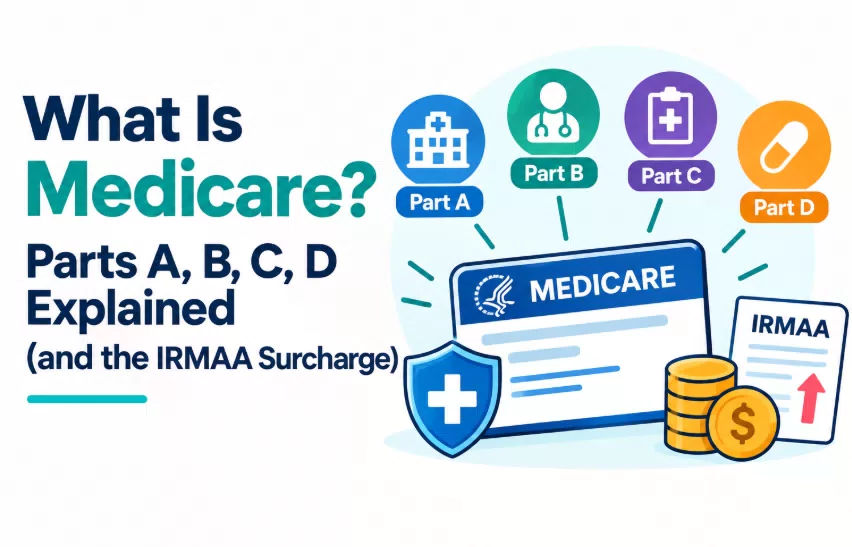
Medicare is the federal health insurance program for people 65 and older (and some younger people with qualifying disabilities), split into four distinct parts that cover different things, cost different amounts, and — critically for anyone planning retirement income — can get meaningfully more expensive based on income you earned two years earlier.
The Four Parts, in Plain Terms
Part A (Hospital Insurance) covers inpatient hospital stays, skilled nursing facility care, hospice, and some home health care. Most people pay no premium for Part A, having already paid into it through Medicare payroll taxes during roughly 10 years (40 quarters) of work.
Part B (Medical Insurance) covers doctor visits, outpatient care, preventive services, and durable medical equipment. Unlike Part A, Part B carries a monthly premium for essentially everyone, which is where income-based surcharges come into play.
Part C (Medicare Advantage) is an alternative way to receive your Parts A and B benefits (often bundled with Part D) through a private insurance company approved by Medicare, rather than through original Medicare directly. Costs, networks, and extra benefits vary significantly by plan.
Part D (Prescription Drug Coverage) covers prescription medications, offered through private insurers, with its own separate premium that varies by plan — and, like Part B, subject to the same income-based surcharge structure.
The 2026 Standard Part B Premium
For 2026, the standard Medicare Part B premium is $202.90 per month, with an annual Part B deductible of $283. This is the baseline cost before any income-based adjustment — the number most beneficiaries will actually pay, unless their income crosses a specific threshold.
IRMAA: The Surcharge Tied to Income From Two Years Ago
IRMAA (Income-Related Monthly Adjustment Amount) is an extra charge added to Part B and Part D premiums for beneficiaries whose income exceeds set thresholds. The detail that catches people off guard: IRMAA for a given year is based on your Modified Adjusted Gross Income from two years prior — your 2026 premium is determined by your 2024 tax return, not your current income.
The 2026 IRMAA Brackets (Based on 2024 MAGI)
Single Filer MAGI | Married Filing Jointly MAGI | Total Part B Premium/Month | Part D Surcharge/Month |
|---|---|---|---|
$109,000 or less | $218,000 or less | $202.90 | $0.00 |
$109,001 – $137,000 | $218,001 – $274,000 | $284.10 | $14.50 |
$137,001 – $171,000 | $274,001 – $342,000 | $405.80 | $37.50 |
$171,001 – $205,000 | $342,001 – $410,000 | $527.50 | $60.40 |
$205,001 – $499,999 | $410,001 – $749,999 | $649.20 | $83.30 |
$500,000 or more | $750,000 or more | $689.90 | $91.00 |
Why IRMAA Works Completely Differently From Income Tax Brackets
This is the single most important thing to understand about IRMAA, and it's the opposite of how federal income tax brackets work. Income tax brackets are marginal — only the portion of income inside a given bracket gets taxed at that bracket's rate, so crossing into a new bracket by one dollar only costs you extra tax on that one dollar.
IRMAA is a cliff, not a marginal system. Cross a threshold by even one dollar, and your entire premium jumps to the new, higher tier for the full year — not just the portion above the threshold.
A Worked Example
Take a single filer whose 2024 MAGI was $108,999 — just under the first IRMAA threshold — compared to a filer whose 2024 MAGI was $109,001, just two dollars over it.
At $108,999 MAGI: Part B premium stays at the standard $202.90/month = $2,434.80/year
At $109,001 MAGI: Part B premium jumps to $284.10/month = $3,409.20/year
Extra annual Medicare cost triggered by $2 of additional income: $974.40
For a married couple where both spouses are enrolled in Medicare and the household crosses the joint threshold, that impact doubles — since IRMAA applies per person, not per household — to nearly $1,949/year in extra combined cost from the same two dollars of income. At the very top of the scale, a single filer with $500,000+ in MAGI pays $689.90/month for Part B alone — $5,844 more per year, per person, than someone at the standard premium.
This cliff structure is exactly why a large one-time income event — a Roth conversion, a big capital gain, a lump-sum retirement account withdrawal — deserves attention two years before it would otherwise seem relevant: the tax return filed this year quietly sets your Medicare premium two years from now.
Appealing an IRMAA Determination
IRMAA isn't always permanent or unappealable. The Social Security Administration (which administers IRMAA determinations, even though it's a Medicare premium) allows beneficiaries to request a reduction using Form SSA-44 if a "life-changing event" has reduced their income since the tax year used for the determination — qualifying events generally include marriage, divorce, death of a spouse, work stoppage or reduction, loss of income-producing property, loss of pension income, or an employer settlement payment. If your two-years-ago tax return no longer reflects your current financial reality due to one of these specific events, this appeal process exists precisely to correct that mismatch rather than forcing you to wait two years for the determination to catch up on its own.
Why This Matters for Retirement Income Planning
Because IRMAA looks backward two years and applies as a hard cliff rather than a gradual increase, it becomes a genuine planning variable rather than just a cost to budget for passively. A Roth conversion, timed without considering this lookback, can push MAGI over a threshold and trigger a materially higher Medicare premium two years later — even if income drops back down immediately afterward. The same applies to the year a large Required Minimum Distribution first lands, or any other deliberate large withdrawal from a traditional retirement account.
This doesn't mean avoiding income-generating moves near retirement — it means modeling the IRMAA impact specifically, two years out, as part of the decision, rather than discovering the premium increase only after it's already locked in.
Medicare Advantage vs. Original Medicare: A Brief Note
Choosing between Part C (Medicare Advantage) and original Medicare (Parts A and B, often with a separate Part D and supplemental "Medigap" policy) is a substantial decision on its own, involving network restrictions, out-of-pocket maximums, and plan-specific benefits that vary significantly by location and insurer. That comparison deserves its own dedicated treatment rather than a brief summary here — the core point for this article is simply that IRMAA's income-based surcharge structure applies to Part B and Part D regardless of which overall path you choose.
Frequently Asked Questions
Does IRMAA apply to Part A?
No. Part A generally carries no premium at all for most beneficiaries, and IRMAA specifically applies only to Part B and Part D.
If my income drops after a high-income year, does IRMAA adjust automatically?
Not automatically — it continues to reflect the tax year used for that year's determination (generally two years prior) unless you file an appeal using Form SSA-44 citing a qualifying life-changing event.
Is IRMAA the same for everyone at a given income level?
It depends on filing status, since the brackets differ for single filers, married filing jointly, and married filing separately (which uses notably narrower, lower thresholds than the other two categories).
Can I avoid IRMAA entirely by staying under the threshold?
Only if your MAGI two years prior stays under the relevant threshold — since IRMAA is a cliff rather than a marginal system, staying even one dollar under the line avoids the entire surcharge tier, which is exactly why the thresholds are worth planning around deliberately rather than treating as an afterthought.
Does everyone have to actively enroll in Medicare at 65?
Many people are automatically enrolled if already receiving Social Security benefits; others need to actively enroll during their Initial Enrollment Period. Missing the enrollment window can carry its own separate, lifelong premium penalties distinct from IRMAA, which is a different topic worth confirming directly based on your specific situation.
Key Takeaways
Medicare's four parts cover different things — hospital care (A), medical/outpatient care (B), a private-insurer bundled alternative (C), and prescription drugs (D) — with Part B's 2026 standard premium at $202.90/month before any income adjustment. IRMAA adds a surcharge to Part B and Part D for higher earners, based on MAGI from two years prior, structured as a hard cliff rather than the marginal, bracket-by-bracket system that governs federal income tax.
That cliff structure is what makes IRMAA a genuine planning consideration rather than a passive cost: the worked example above shows how just two dollars of additional 2024 income can trigger roughly $974 in extra 2026 Medicare costs for a single filer — which is exactly why large income events like Roth conversions or sizable withdrawals are worth evaluating specifically for their IRMAA impact two years out, not just their immediate tax consequences.
Sources
Centers for Medicare & Medicaid Services — 2026 Medicare Parts A & B Premiums and Deductibles
Social Security Administration — Medicare Premiums: Rules for Higher-Income Beneficiaries
This article is for general educational purposes only and does not constitute financial, investment, tax, or legal advice.