What Is Dollar-Cost Averaging? Strategy, Formula & Real Example
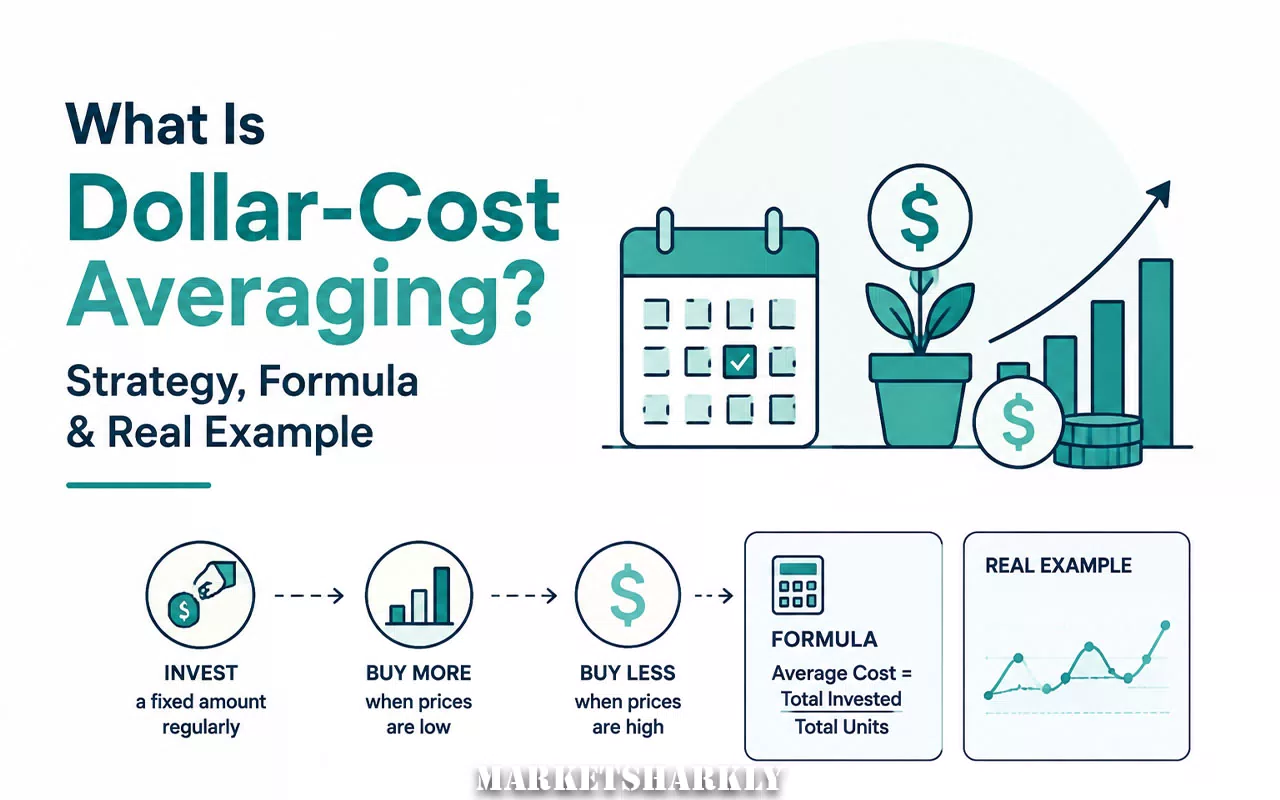
Dollar-cost averaging (DCA) is the practice of investing a fixed amount of money at regular intervals, regardless of what the price is doing at the time — rather than trying to pick the "right" moment to put a lump sum in all at once. The SEC's Investor.gov describes it simply: investing your money in equal portions, at regular intervals, regardless of the ups and downs in the market.
The idea traces back to Benjamin Graham's 1949 book The Intelligent Investor, and it remains one of the most widely recommended strategies for regular, ongoing investing — largely because it removes a decision most people, including professionals, are bad at making: guessing when prices are about to rise or fall.
The Mechanism: Why It Works
The math behind DCA is straightforward. If you invest the same dollar amount every period, you automatically buy more shares when the price is low and fewer shares when the price is high — simply because a fixed dollar amount buys more units of something cheap and fewer units of something expensive.
That alone doesn't guarantee a better outcome than any other approach, but it does something specific: it lowers your average cost per share compared to the simple average price over the same period, whenever prices fluctuate. Those two numbers — average cost per share and simple average price — sound similar but aren't the same, and the gap between them is the entire mechanical benefit of DCA.
A Worked Example
Say you invest $500 a month for five months into a stock whose price moves like this: $25, $20, $12.50, $20, $25 — a dip in the middle, then a full recovery.
Month | Price | Shares Bought ($500 ÷ Price) |
|---|---|---|
1 | $25 | 20.00 |
2 | $20 | 25.00 |
3 | $12.50 | 40.00 |
4 | $20 | 25.00 |
5 | $25 | 20.00 |
Total invested: $2,500. Total shares purchased: 130.
Average cost per share: $2,500 ÷ 130 ≈ $19.23
Compare that to the simple average of the five prices — ($25 + $20 + $12.50 + $20 + $25) ÷ 5 = $20.50. DCA's average cost per share came out lower than the simple average price, specifically because more money automatically flowed into shares during the $12.50 dip in month 3, when $500 bought 40 shares instead of the 20 it bought at $25.
If the price ends back at $25 in month 5, that 130-share position would be worth $3,250 — compared to investing the full $2,500 as a lump sum in month 1 at $25, which would have bought only 100 shares, worth $2,500 at that same ending price. In this particular price path, spreading the purchases out captured the dip better than the lump sum did.
Why DCA Doesn't Always Win
That example makes DCA look great, but it was drawn from a price path with a dip and a recovery — the scenario where DCA performs at its best relative to a lump sum. It isn't the only realistic scenario, and DCA isn't a strategy that outperforms a lump sum by design.
If, instead, prices had simply risen steadily throughout the five months, a lump sum invested in month 1 would have bought more total shares at the lowest price of the period and ended up ahead of the DCA approach, which would have kept buying at progressively higher prices along the way. Historically, because markets have risen more often than they've fallen over long periods, investing a lump sum immediately has, on average, outperformed spreading the same amount out via DCA — DCA's advantage shows up specifically in scenarios involving a meaningful dip during the investment window, not universally.
FINRA is explicit about this trade-off: dollar-cost averaging doesn't guarantee a profit or protect against loss in a declining market, and it involves continuous investment, so investors should consider their ability to keep investing through periods when prices are falling.
What DCA Is Actually Solving For
If DCA doesn't reliably beat a lump sum, why is it still one of the most recommended strategies? Because for most people, the realistic alternative to DCA isn't "optimally timed lump sum investing" — it's misjudged timing driven by emotion, or simply never investing at all because the "right moment" never feels obvious.
DCA's real advantage is behavioral, not purely mathematical. It replaces a difficult, high-stakes judgment call — is now a good time to invest a large sum? — with a fixed, repeatable habit that doesn't require predicting the market at all. It also naturally fits how most people actually receive money to invest in the first place: not as a single windfall, but as a portion of each paycheck, arriving on a schedule.
Where DCA Shows Up in Practice
DCA isn't a special account type or product — it's a pattern of behavior that shows up in a few common forms:
Automatic retirement contributions, such as a 401(k) deducted from every paycheck, are DCA by default, whether or not the investor thinks of it that way.
Automated recurring investments into a brokerage account or fund, set up to invest a fixed amount on a set schedule.
Deliberately spreading out a lump sum — an inheritance, a bonus, or a large windfall — in equal portions over a chosen number of months, instead of investing it all on day one.
Frequently Asked Questions
Does dollar-cost averaging guarantee a profit?
No. It's a risk-management approach to how you invest over time, not a guarantee against loss — if the underlying investment's value falls and doesn't recover, DCA doesn't prevent that loss.
Is dollar-cost averaging better than investing a lump sum all at once?
Not universally. Historically, lump-sum investing has outperformed DCA more often than not, since markets have trended upward over most long periods. DCA's advantage shows up specifically when prices dip meaningfully during the investment window.
Do I need a special account to dollar-cost average?
No. It's simply the practice of investing a fixed amount on a regular schedule — it can be automated through a standard brokerage account, a retirement account, or done manually.
Is a 401(k) contribution a form of dollar-cost averaging?
Yes. Regular paycheck deductions into a 401(k), invested the same way each pay period, follow the same mechanism as any other DCA approach, even if it isn't usually labeled that way.
What's the main benefit of DCA if it doesn't reliably beat a lump sum?
Its main advantage is behavioral: it replaces the difficult task of guessing the right time to invest with a consistent, repeatable habit, which for many investors leads to actually investing consistently rather than waiting for a "better" moment that may never come.
Key Takeaways
Dollar-cost averaging means investing a fixed amount at regular intervals regardless of price, which mechanically buys more shares when prices are low and fewer when they're high — lowering your average cost per share relative to the simple average price whenever the market fluctuates along the way.
It isn't a strategy that reliably beats investing a lump sum immediately, and it doesn't protect against a genuine, sustained decline. Its real value for most investors is behavioral: a consistent, automatic habit that sidesteps the nearly impossible task of timing the market, and that fits naturally with how most people actually receive money to invest in the first place.
Sources
This article is for general educational purposes only and does not constitute financial, investment, tax, or legal advice.
Last updated: August 2026