What Is Dividend Yield? Formula, Examples & Why a High Yield Can Be a Warning Sign
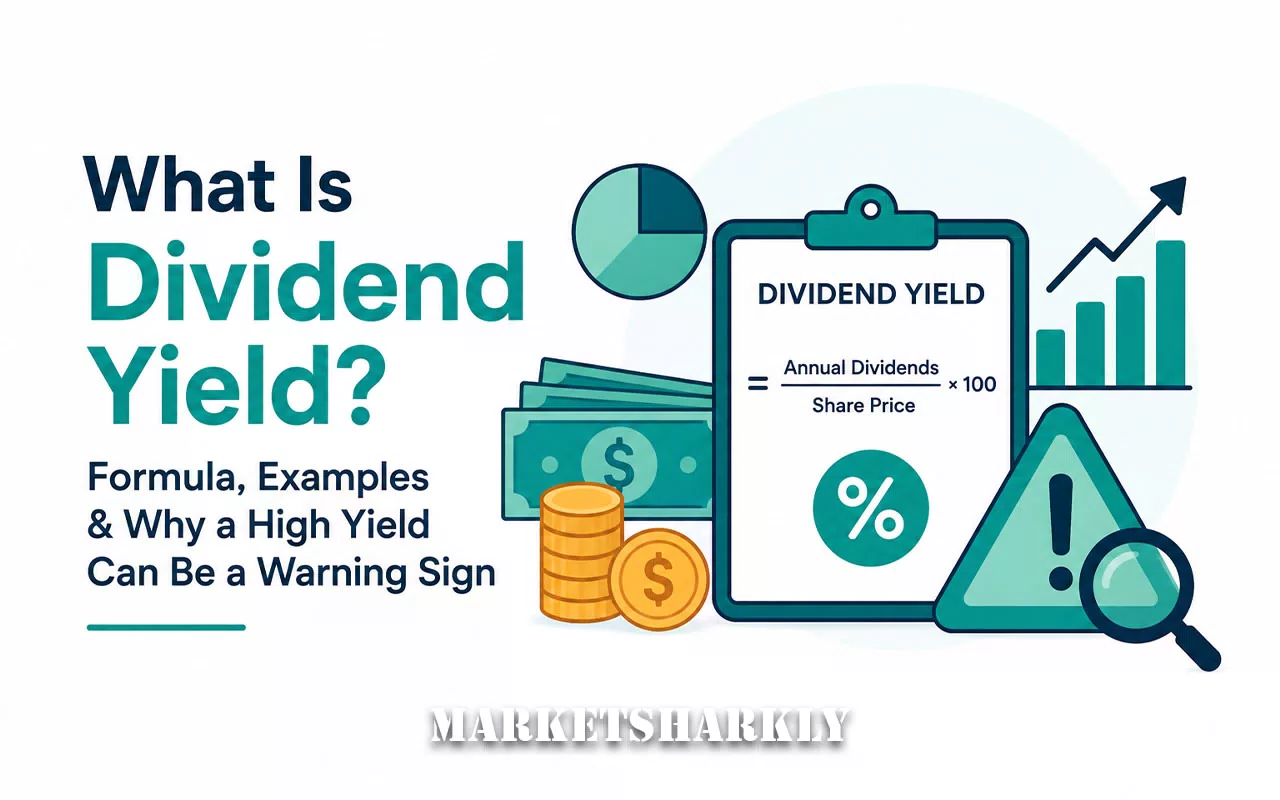
Dividend yield is a simple ratio that tells you how much cash income a stock pays out relative to its price. It's one of the first numbers income-focused investors look at — and also one of the easiest to misread, because the yield can rise for a genuinely good reason or a genuinely bad one, and the number alone doesn't tell you which.
What a Dividend Is, First
A dividend is a portion of a company's profit paid out to shareholders, typically in cash, on a schedule the company sets — most often quarterly in the U.S., though some companies pay monthly, semi-annually, or annually. Companies aren't required to pay dividends, and not all do; many growth-focused companies reinvest profits back into the business instead.
An unscheduled payment outside a company's normal dividend schedule is generally called a special or extra dividend.
The Dividend Yield Formula
Dividend Yield = (Annual Dividend per Share ÷ Current Share Price) × 100
If a company pays $0.60 per share each quarter, its annualized dividend is $2.40 per share. At a $48 share price:
Dividend Yield = ($2.40 ÷ $48) × 100 = 5%
That 5% figure tells you the dividend income alone represents 5% of what you'd pay to buy the stock today — nothing about price appreciation is included in that number.
Why the Same Dividend Can Produce a Different Yield
Because yield is a ratio against price, the yield moves even when the dividend itself doesn't change — it just takes a moving share price to do it.
Using that same $2.40 annual dividend:
Share Price | Dividend Yield |
|---|---|
$30 | 8.0% |
$48 | 5.0% |
$60 | 4.0% |
The dividend payment is identical in all three rows. What changes is the price you'd be paying to receive it. This is the single most important thing to understand about dividend yield: a rising yield doesn't necessarily mean the dividend got better — it can simply mean the share price fell.
Why a High Yield Isn't Automatically Good News
A stock's yield can climb for two very different reasons, and telling them apart matters.
Reason one: the company raised its dividend. This is generally a sign of confidence — the company is generating enough profit to return more of it to shareholders.
Reason two: the share price dropped. If the market has soured on a company — declining revenue, deteriorating fundamentals, rising debt — the share price can fall sharply while the dividend, for a while, stays exactly where it was. The yield shoots up not because shareholders are being rewarded more, but because the stock is cheaper for a reason.
That second scenario is sometimes called a yield trap: a yield that looks unusually attractive precisely because the underlying business is struggling, and the market is pricing in doubt about whether that dividend can actually be sustained. A yield noticeably higher than similar companies in the same sector is worth investigating rather than treating as a straightforward bonus.
The Payout Ratio: A Sustainability Check
One way to gauge whether a dividend looks sustainable is the payout ratio — the percentage of a company's earnings being paid out as dividends, calculated as dividends per share divided by earnings per share.
A payout ratio comfortably below 100% suggests the company is paying out less than it earns, leaving room to maintain the dividend even if profits dip somewhat. A payout ratio at or above 100% means the company is paying out more than it's currently earning — which isn't automatically unsustainable in the short term, but it's a signal worth understanding rather than ignoring, since it can't continue indefinitely without either earnings recovering or the dividend eventually being cut.
Dividend Yield Isn't the Same as Total Return
Yield only measures the cash income portion of what a stock might return — it says nothing about whether the share price itself goes up or down. A stock's actual total return combines both.
Consider two hypothetical stocks over the same year:
Stock A: 5% dividend yield, share price unchanged → total return ≈ 5%
Stock B: 1% dividend yield, share price up 15% → total return ≈ 16%
Stock A has the more attractive yield by a wide margin, but Stock B produced the better overall result once price appreciation is included. Focusing on yield alone, without considering total return, can lead to comparing the wrong thing — a high-yield stock that goes nowhere in price isn't automatically a better investment than a low-yield stock that appreciates.
Frequently Asked Questions
Is a higher dividend yield always better?
Not automatically. A high yield can reflect a genuinely strong, well-supported dividend, or it can reflect a falling share price and doubts about whether the dividend will hold. The payout ratio and the reason behind the yield matter as much as the number itself.
Does dividend yield include stock price growth?
No. Dividend yield measures only the cash dividend relative to price — it says nothing about capital gains or losses. Total return is the metric that combines both.
Why did a stock's yield change even though the dividend stayed the same?
Yield is a ratio against the current share price, so if the price moves and the dividend doesn't, the yield moves too — up when price falls, down when price rises.
What's a "yield trap"?
A situation where a stock's yield looks unusually high mainly because its share price has dropped due to underlying business problems, raising real doubt about whether the dividend can be sustained at that level going forward.
Do all stocks pay dividends?
No. Companies choose whether to pay dividends, and many — particularly earlier-stage or growth-focused companies — reinvest profits into the business instead of distributing them to shareholders.
Key Takeaways
Dividend yield is a straightforward ratio — annual dividend per share divided by share price — but it's a ratio, which means it can rise for a good reason (a bigger dividend) or a concerning one (a falling stock price), and the number alone doesn't tell you which happened.
Checking the payout ratio and comparing yield against similar companies in the same sector helps separate a genuinely well-supported dividend from a yield trap. And because yield only captures income, not price movement, it's a piece of the total-return picture — not the whole picture on its own.
Sources
U.S. Securities and Exchange Commission — Investor.gov Glossary: Dividend
U.S. Securities and Exchange Commission — Investor.gov, Investment Products
This article is for general educational purposes only and does not constitute financial, investment, tax, or legal advice.
Last updated: August 2026