What Is Debt-to-Income Ratio (DTI)? How Lenders Calculate It
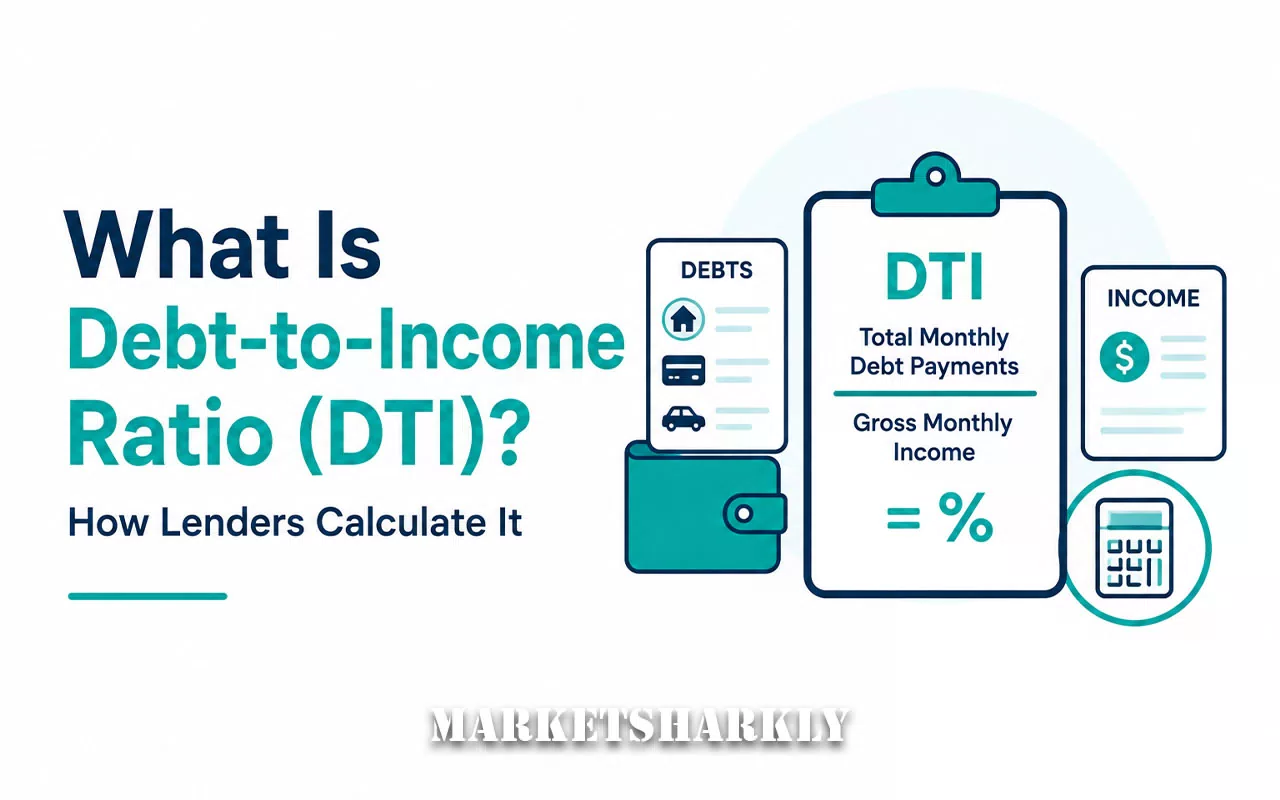
Debt-to-income ratio, or DTI, is all your monthly debt payments divided by your gross monthly income, expressed as a percentage. It's one of the two central numbers — alongside your credit score — that lenders lean on to judge whether you can realistically handle a new loan payment on top of what you're already committed to paying every month.
The Basic Calculation
DTI = (Total Monthly Debt Payments ÷ Gross Monthly Income) × 100
Gross monthly income is your income before taxes and other deductions — not your take-home pay.
Total monthly debt payments include recurring, required debt obligations: your current mortgage or rent, auto loans, student loans, minimum credit card payments, personal loans, and any court-ordered child support or alimony. It does not include everyday living costs like groceries, utilities, insurance premiums, phone bills, or subscriptions — DTI is specifically a measure of debt obligations, not total spending.
A Worked Example
Say your gross monthly income is $7,200, and your monthly obligations are:
Obligation | Monthly Payment |
|---|---|
Mortgage or rent | $1,850 |
Auto loan | $420 |
Student loan | $280 |
Credit card minimum | $150 |
Total | $2,700 |
DTI = ($2,700 ÷ $7,200) × 100 ≈ 37.5%
Front-End vs. Back-End DTI
Lenders, particularly in mortgage underwriting, often look at two versions of this ratio at once, sometimes written together as a pair like "28/36."
Front-end ratio looks only at housing costs — mortgage principal and interest, property taxes, homeowners insurance, and any HOA dues — as a share of gross income. Using the example above, with $1,850 in housing costs against $7,200 income, the front-end ratio is ≈25.7%.
Back-end ratio is the full DTI calculation described above — all debts, not just housing — which is why it's the higher of the two numbers (37.5% in this example) and the one most often referenced simply as "DTI."
A commonly cited conventional guideline puts the front-end ratio around 28% or below and the back-end ratio around 36% or below, though actual approved ratios vary meaningfully by loan program, lender, and the strength of the rest of your application.
Where the 43% Number Actually Comes From — and Why It's More Nuanced Than It Sounds
This is a detail a lot of DTI content gets wrong or oversimplifies, so it's worth being precise about it.
Following the 2008 financial crisis, the CFPB's Ability-to-Repay/Qualified Mortgage rule originally set a hard 43% DTI cap for a loan to qualify as a "General QM" — a category of mortgage that gives lenders certain legal protections for having reasonably verified a borrower's ability to repay.
That changed in 2021. The CFPB removed the strict 43% cap for General QM loans and replaced it with a price-based test instead — a loan can qualify as a General QM as long as its APR doesn't exceed the average prime offer rate for a comparable loan by more than a set margin, regardless of the exact DTI number. Lenders are still required to consider a borrower's DTI ratio or residual income as part of the underwriting process, just without a rigid federal cutoff tied specifically to 43%.
Despite that regulatory change, 43% has remained a widely used industry benchmark anyway — many lenders and loan programs still treat it as a practical ceiling, and some automated underwriting systems for conventional loans can approve higher ratios, sometimes up to around 50%, for borrowers with compensating factors like strong credit, meaningful savings, or a lower loan-to-value ratio on the property. In other words: there's no single current federal DTI limit locking every borrower to 43%, but plenty of real-world lending decisions still cluster around that number as an informal standard.
Why Lenders Care About DTI in the First Place
DTI is fundamentally a measure of how much room is left in your monthly budget. A lower DTI signals more breathing room to absorb a new payment without financial strain; a higher DTI signals your income is already largely committed elsewhere, which raises the perceived risk that a missed payment becomes more likely if anything in your finances goes sideways.
DTI and credit score measure different things and aren't substitutes for each other: credit score reflects your track record of repaying debt on time; DTI reflects your current capacity to take on more of it, regardless of how well you've repaid in the past. A borrower with an excellent credit score can still be turned down, or offered less favorable terms, on a loan that would push their DTI too high.
How Paying Down a Single Debt Can Move the Number Meaningfully
Because DTI is a ratio, not a fixed value, paying off even one recurring obligation can shift it substantially — sometimes more than a comparable-sized change in income would.
Using the earlier example, paying off that $420/month auto loan entirely — with income and other debts unchanged — brings total monthly debt down to $2,280:
New DTI = ($2,280 ÷ $7,200) × 100 ≈ 31.7%
That's nearly a 6-percentage-point drop from a single paid-off obligation, which illustrates why lenders and financial advisors often point specifically to eliminating a recurring monthly debt, rather than simply earning more, as one of the more direct ways to improve DTI before a major loan application.
How Much Room a Given DTI Target Leaves for a New Loan
Working backward from a target ratio is often more useful than just knowing your current number. If this same $7,200/month earner wanted to stay at or below a 43% DTI while taking on a new loan, their maximum allowable total monthly debt would be:
$7,200 × 43% = $3,096
Since $1,730 of that ($280 student loan + $150 credit card + $1,300 hypothetical remaining after paying off the auto loan) is unrelated to housing, working out exactly how much new mortgage payment fits under that $3,096 ceiling — alongside existing non-housing debts — is the kind of calculation a loan officer runs early in the mortgage qualification conversation, since it directly caps how large a home purchase price realistically makes sense.
Ways DTI Commonly Gets Improved Before a Major Loan Application
Paying down or paying off a recurring debt — as shown above, eliminating a whole monthly obligation moves the ratio more directly than most other single actions.
Avoiding new debt in the months leading up to a mortgage or major loan application, since a new car loan or a newly opened credit line raises the debt side of the ratio right when a lender is about to evaluate it.
Increasing verifiable income, though this generally moves the needle more slowly than debt reduction, and lenders typically want to see income that's stable and documented, not a one-time bonus.
Avoiding closing old credit accounts right before applying, since — while this affects credit utilization and credit history length more directly than DTI itself — the timing of major credit moves before a loan application is worth coordinating deliberately rather than incidentally.
Frequently Asked Questions
Is there a single federal maximum DTI I'm legally allowed to have for a mortgage?
Not since 2021, for General QM loans specifically — that hard 43% cap was replaced with a price-based standard. In practice, 43% remains a common lender benchmark, but actual approved ratios vary by loan program and lender.
Does DTI include my rent if I don't own a home yet?
Yes, current rent counts as a recurring debt-like obligation for DTI purposes while you're a renter — the housing side of the ratio simply comes from your rent payment instead of a mortgage.
Do utility bills or insurance count toward DTI?
No. DTI captures recurring debt obligations specifically — loans, minimum credit card payments, and court-ordered payments — not general household expenses like utilities, groceries, or insurance premiums (property insurance folded into a mortgage payment for front-end ratio purposes is the specific exception).
Can I get approved for a mortgage with a DTI above 43%?
Often yes, particularly with strong compensating factors like excellent credit, significant savings, or specific loan programs (some FHA loans, for instance, can accommodate higher ratios) — 43% functions as a common benchmark rather than an absolute barrier for every loan type.
Is a lower DTI always better?
For loan qualification purposes, generally yes — lower signals more repayment capacity. That said, DTI is just one factor among several (credit score, employment history, down payment, cash reserves) that a full underwriting decision weighs together.
Key Takeaways
DTI measures total monthly debt obligations against gross monthly income, and it's one of the primary numbers lenders use to judge how much additional loan payment a borrower can realistically absorb. The often-cited 43% threshold originated as a hard federal cap for Qualified Mortgages, but that specific cap was replaced by a price-based test in 2021 — even though 43% has stuck around informally as a widely used industry benchmark.
Because DTI is a ratio, targeted debt payoff — even on a single account — can move the number more dramatically than a comparable increase in income, which is why it's often the more immediately actionable lever for someone preparing for a major loan application.
Sources
Consumer Financial Protection Bureau — What Is a Debt-to-Income Ratio?
Consumer Financial Protection Bureau — Summary of the Ability-to-Repay and Qualified Mortgage Rule
This article is for general educational purposes only and does not constitute financial, investment, tax, or legal advice.