What Is Asset Allocation? How to Divide Your Portfolio (With a Rebalancing Example)
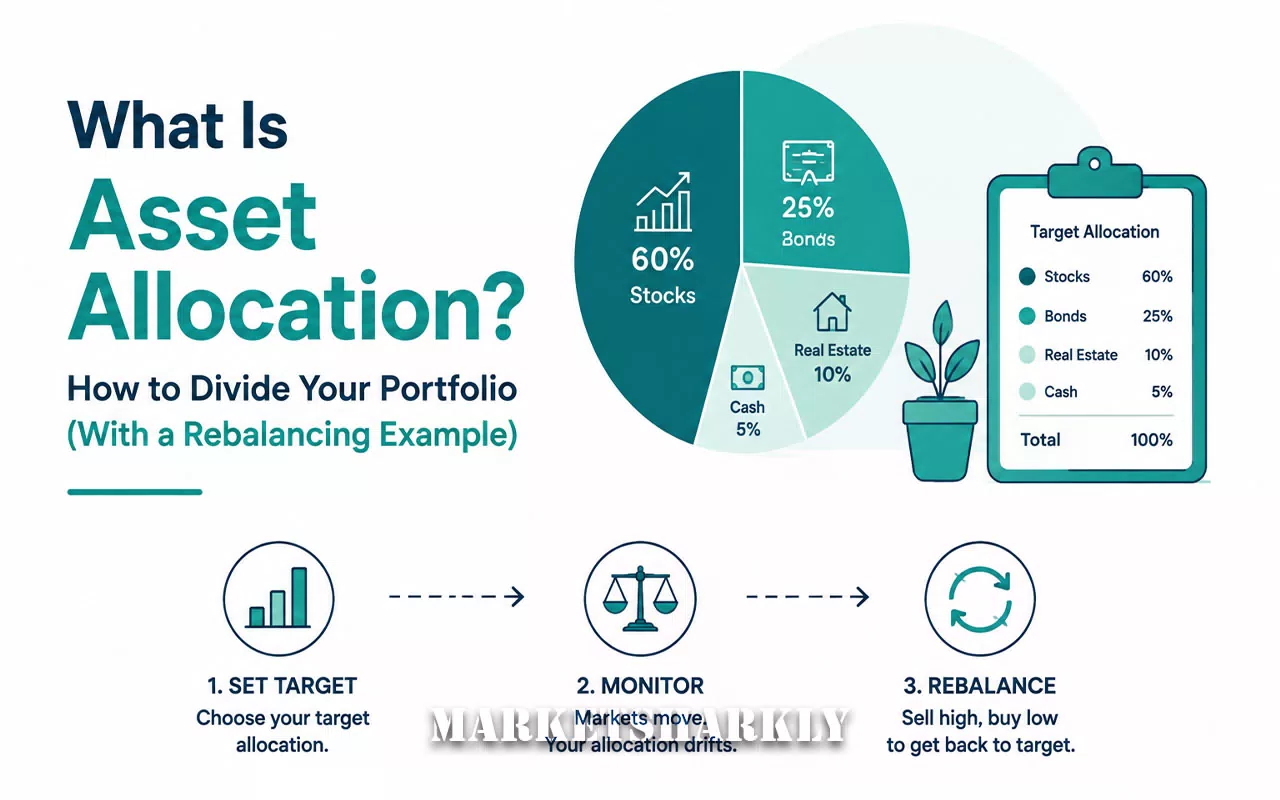
Asset allocation is how you divide your investment portfolio among different broad categories of investments — commonly stocks, bonds, and cash — rather than holding everything in one type of asset. The SEC's Investor.gov describes it plainly: asset allocation involves dividing your investments among different assets, and the right mix is a personal decision that depends on your specific situation, not a single formula everyone should follow.
The Three Core Asset Classes
Stocks (equities) generally offer the highest long-term growth potential among the three, paired with the most volatility — meaning larger short-term swings, in either direction.
Bonds (fixed income) generally offer more modest, steadier returns than stocks, along with less volatility, though they still carry risk, including the risk that an issuer fails to pay as promised.
Cash and cash equivalents — savings accounts, money market funds, short-term CDs — offer the most stability and immediate access, generally at the cost of the lowest long-term growth potential.
Some investors also include alternative assets — real estate, commodities, and others — outside these three core categories, though stocks, bonds, and cash remain the foundational building blocks most asset allocation decisions start from.
The Two Factors That Drive Your Allocation
According to the SEC, the allocation that fits you best depends primarily on two things.
Time horizon is how long you plan to invest before you'll need the money. Investors with a longer time horizon may feel comfortable taking on riskier or more volatile investments, since there's more time available to recover from a downturn before the money is needed. Someone investing for a goal that's decades away is generally in a different position than someone who needs the funds in two years.
Risk tolerance is your ability and willingness to lose some or all of your original investment in exchange for the potential for greater returns. This isn't purely a numbers question — genuine willingness to sit through a significant paper loss without panic-selling matters just as much as the math of how long you have to recover.
Because both factors are personal and change over time, there's no single "correct" allocation — the SEC explicitly frames this as a personal decision that shifts across different periods of your life, most commonly as your time horizon shortens.
Why Allocation, Not Just Diversification, Matters
Diversification and asset allocation are related but distinct ideas. Diversification is the practice of spreading money among different investments to reduce risk — summed up in the "don't put all your eggs in one basket" idea. Asset allocation is specifically about how much goes into each broad category before you even get to diversifying within it.
You can diversify within a single asset class — holding many different stocks across different industries, for example — but that alone doesn't diversify you across asset classes. A portfolio that's 100% stocks, spread across 50 different companies, is well-diversified within equities but has zero allocation to bonds or cash, so it carries the full volatility profile of the stock market as a whole. Allocation is the higher-level decision; diversification happens within and across whatever allocation you've chosen.
A Worked Rebalancing Example
Say you start with a $100,000 portfolio targeted at 60% stocks and 40% bonds — $60,000 in stocks, $40,000 in bonds.
Over the following year, suppose stocks gain 25% while bonds gain a more modest 3%. Your portfolio is now:
Stocks: $60,000 × 1.25 = $75,000
Bonds: $40,000 × 1.03 = $41,200
Total: $116,200
Because stocks grew so much faster than bonds, your actual allocation has drifted — you're now at roughly 64.5% stocks and 35.5% bonds, even though you never made a single trade. Nobody decided to take on more stock risk; the market did it for you simply by stocks outperforming bonds.
Rebalancing means selling enough of the overperforming asset and buying enough of the other to return to your original target — in this case, selling about $5,280 worth of stocks and moving it into bonds to get back to the 60/40 split on the new $116,200 total.
Why Rebalancing Matters
Left alone, a portfolio's actual allocation drifts over time simply because different asset classes grow at different rates — exactly what happened in the example above. Without rebalancing, a portfolio that started at a comfortable 60/40 risk level can gradually become an 80/20 or 90/10 portfolio after a strong multi-year stock run, carrying meaningfully more risk than originally intended, without the investor ever deciding to take that risk on.
Rebalancing brings the portfolio back in line with the original decision about time horizon and risk tolerance — it isn't a bet on which asset will do better next, it's a mechanical correction back to the plan.
How Allocation Typically Shifts Over Time
The most common reason people change their asset allocation isn't a change of opinion about the market — it's a change in time horizon. As a specific goal (retirement, a home purchase, a child's education) gets closer, many investors gradually shift toward a larger share of bonds and cash and a smaller share of stocks, prioritizing stability over growth potential as the point where the money will actually be needed approaches.
This is also the mechanism behind target-date funds (sometimes called lifecycle funds) — a single fund that automatically shifts its own stock/bond/cash mix to become more conservative as it approaches a stated target year, handling the allocation and rebalancing decisions on the investor's behalf.
Frequently Asked Questions
Is there an ideal asset allocation everyone should use?
No. The SEC is explicit that this is a personal decision based on your own time horizon and risk tolerance, both of which differ from person to person and change over the course of a single person's life.
How often should I rebalance?
There's no single federally mandated schedule — common approaches include rebalancing on a set calendar interval (such as annually) or whenever an asset class drifts beyond a chosen threshold from its target. The right cadence depends on the investor's own portfolio and preferences.
Does rebalancing cost anything?
It can, depending on the account type and the specific investments involved — transaction costs and, in a taxable account, potential tax consequences from selling appreciated assets are worth considering as part of a rebalancing decision.
Is a more aggressive (stock-heavy) allocation always riskier?
Generally, yes, in terms of short-term volatility — but "riskier" isn't automatically "wrong" for every investor. A long time horizon and high risk tolerance may make a stock-heavy allocation a reasonable fit for a specific investor's situation.
What's the difference between asset allocation and diversification?
Asset allocation determines how much of a portfolio goes into each broad category (stocks, bonds, cash). Diversification is spreading investments within and across those categories to reduce the impact of any single investment performing poorly.
Key Takeaways
Asset allocation is the decision of how much of a portfolio to hold in stocks, bonds, and cash, driven primarily by time horizon and risk tolerance — both personal factors with no universal right answer.
Because different asset classes grow at different rates, an allocation drifts on its own over time even without any deliberate decision to change it, which is exactly what rebalancing exists to correct. Revisiting the allocation as circumstances change — especially as a time horizon shortens — is a normal, expected part of managing a portfolio, not a sign the original plan was wrong.
Sources
This article is for general educational purposes only and does not constitute financial, investment, tax, or legal advice.
Last updated: August 2026