What Is a Trust? Revocable vs. Irrevocable Trusts Explained
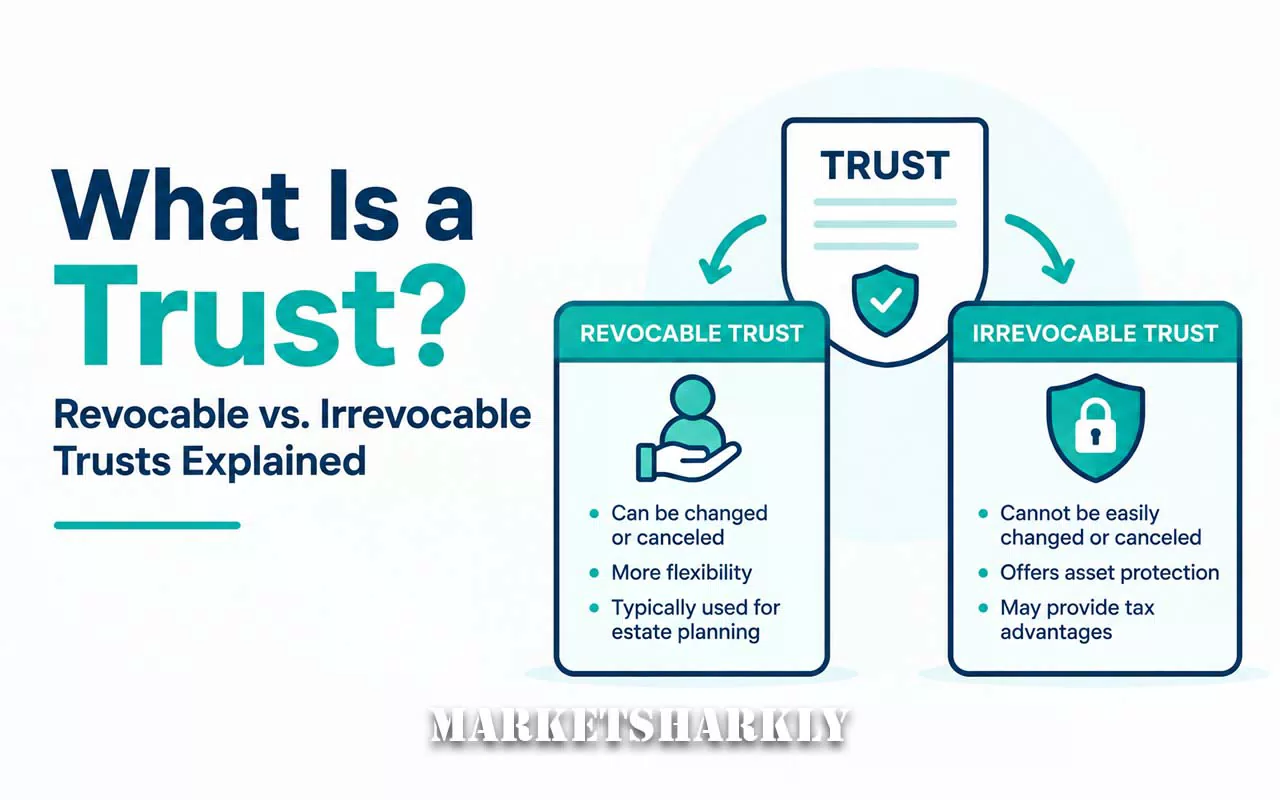
A trust is a legal arrangement where one party (the grantor, sometimes called the settlor) transfers assets to be held and managed by another party (the trustee) for the benefit of a third party (the beneficiary). The grantor, trustee, and beneficiary can overlap — it's common for the same person to be both grantor and trustee of their own trust while they're alive — but the structure always involves those three defined roles.
The single most important distinction between trust types is whether it's revocable or irrevocable, and that one word changes almost everything else about how the trust behaves — legally, financially, and for tax purposes.
Revocable Trusts: What They Actually Do (and Don't Do)
A revocable trust — often called a living trust — can be changed, amended, or completely dissolved by the grantor at any time while they're alive and have capacity to do so. The grantor typically retains full control, often serving as their own trustee and continuing to manage the assets exactly as they did before the trust existed.
Here's the detail that surprises a lot of people: a revocable trust does not save you money on income taxes, and it does not remove assets from your taxable estate. Because the grantor retains the power to revoke the trust and reclaim the assets, the IRS treats it as a grantor trust — the trust itself is disregarded for federal income tax purposes, and all of its income, deductions, and credits are reported directly on the grantor's own personal tax return, exactly as if the trust didn't exist. The assets remain part of the grantor's gross estate for federal estate tax purposes as well.
So what does a revocable trust actually accomplish? Its primary, genuine benefits are:
Avoiding probate. Assets titled in the name of the trust bypass the probate court process at death, transferring to beneficiaries according to the trust's terms rather than through a public court proceeding.
Privacy. Unlike a will, which typically becomes a matter of public record once filed with probate court, a trust's terms generally remain private.
Continuity during incapacity. If the grantor becomes unable to manage their own affairs, a successor trustee (named in advance in the trust document) can step in and manage the trust's assets without requiring a separate court-supervised guardianship or conservatorship proceeding.
A revocable trust automatically becomes irrevocable the moment the grantor dies — at that point, a successor trustee takes over, and the trust's terms generally can no longer be changed by anyone, including the beneficiaries, unless the trust document specifically allows for it.
Irrevocable Trusts: A Genuinely Different Structure
An irrevocable trust, by its terms, cannot be modified, amended, or revoked by the grantor once it's established (with limited exceptions in some states, generally requiring beneficiary consent or a court process). Because the grantor gives up control over the assets — including, typically, the ability to reclaim them — irrevocable trusts can accomplish things a revocable trust structurally cannot:
Removing assets from the taxable estate. Since the grantor no longer controls or owns the assets in any meaningful legal sense, a properly structured irrevocable trust can move those assets outside the grantor's estate for federal estate tax purposes — the primary reason wealthier individuals use them as an estate tax planning tool.
Asset and creditor protection. Because the assets legally belong to the trust rather than the grantor, they're generally shielded from the grantor's personal creditors and legal judgments in ways a revocable trust's assets are not, since revocable trust assets are still treated as the grantor's own property.
Medicaid and long-term care planning. Certain irrevocable trust structures are used specifically to address how assets are counted for Medicaid eligibility purposes, subject to lookback periods and rules that vary significantly and are worth discussing with a specialist given how fact-specific and state-dependent this area is.
The tax treatment of an irrevocable trust is more varied than a revocable trust's straightforward "disregarded entity" status. An irrevocable trust can still be classified as a grantor trust for income tax purposes — taxing the income to the grantor personally — if it retains certain specific powers defined in the Internal Revenue Code, even though it's irrevocable. Otherwise, it's typically treated as its own separate taxpayer, filing its own return (Form 1041) and potentially paying tax at compressed trust tax brackets that reach the top rate at a much lower income level than individual brackets do.
A Detail That Trips People Up: State Law Fills the Gaps
If a trust document doesn't explicitly state whether it's revocable or irrevocable, state law determines the default — and states genuinely disagree. Some states presume a trust is revocable unless the document says otherwise; others, including New York, presume the opposite — that a trust is irrevocable unless it explicitly states it can be revoked. This isn't a minor technicality: using the wrong assumed default, or failing to use the exact language a specific state expects, can produce a trust that behaves completely differently from what the grantor intended. It's a strong argument for having trust documents drafted with attention to the specific state's rules, rather than relying on a generic template.
How Common Are Trusts, Actually?
According to a recent Congressional Research Service report, roughly 8% to 11% of Americans have some type of trust — overwhelmingly revocable trusts used to avoid probate. A much smaller share, estimated at under 3 million people (about 1%), have an irrevocable trust structured so that income taxes are paid separately by the trust or its beneficiaries rather than by the original grantor. That gap reflects the different purposes each type serves: revocable trusts are a broadly useful estate-planning tool for avoiding probate regardless of wealth level, while irrevocable trusts used for estate tax minimization are concentrated among wealthier individuals, since federal estate tax itself only applies above a high exemption threshold that the large majority of estates never reach.
Trust vs. Will: Not an Either-Or Choice
A trust doesn't replace the need for a will in most cases — many people use both together. A common structure is a pour-over will, which acts as a backstop: any assets that weren't formally transferred into the trust during the grantor's lifetime get directed into the trust at death, still going through probate for that specific leftover property, but ultimately ending up distributed according to the trust's terms.
A will alone still goes through probate for everything it covers. A trust, properly funded (meaning assets are actually retitled into the trust's name, not just mentioned in the trust document), avoids probate for whatever it holds — but only for what's actually been transferred into it, which is a common and costly mistake: creating a trust document without actually moving assets into the trust's ownership defeats much of the point.
Frequently Asked Questions
Does putting my house in a revocable trust protect it from creditors?
No. Because you retain control and can reclaim the assets at any time, a revocable trust's assets are still treated as your own property for creditor purposes — asset protection is generally a feature of irrevocable trusts, not revocable ones.
Do I still need a will if I have a revocable trust?
Most estate planners recommend having both — a pour-over will to catch any assets not formally transferred into the trust, and to name guardians for minor children, which a trust document doesn't typically address.
Can I change my mind and modify an irrevocable trust later?
Generally not unilaterally, which is the defining trade-off of this structure. Some states allow modification through a legal process called decanting, or with the consent of all beneficiaries, but this is far more restrictive than a revocable trust's flexibility, and shouldn't be assumed available without confirming your specific state's rules.
Does a revocable trust reduce my income taxes while I'm alive?
No. The IRS treats a revocable trust as a grantor trust, meaning all trust income is taxed directly to you personally, exactly as if the assets were held in your own name rather than the trust's.
Is a trust only useful for wealthy people?
No, though the two trust types serve different audiences. Revocable trusts are commonly used by people at a wide range of wealth levels specifically to avoid probate and plan for incapacity, while irrevocable trusts aimed at reducing federal estate tax are more relevant for estates large enough to exceed the federal estate tax exemption threshold.
Key Takeaways
A revocable trust offers flexibility and control during the grantor's life — and real benefits around probate avoidance, privacy, and incapacity planning — but it provides no income tax savings and doesn't remove assets from the taxable estate, since the IRS treats it as though the grantor still owns everything directly. An irrevocable trust trades that flexibility away permanently in exchange for genuine estate tax reduction and asset protection benefits that a revocable trust structurally cannot provide.
Because state law fills in critical gaps — including, in some states, defaulting to irrevocable when a trust document doesn't specify — and because a trust only avoids probate for assets actually retitled into it, working with a qualified estate planning attorney familiar with your specific state's rules matters more here than in most other financial decisions covered by a single general formula.
Sources
Internal Revenue Service — Abusive Trust Tax Evasion Schemes: Questions and Answers
Congressional Research Service — Trusts: Income and Estate and Gift Tax Issues (R48879)
Cornell Law School Legal Information Institute — Irrevocable Trust
This article is for general educational purposes only and does not constitute financial, investment, tax, or legal advice.