What Is a Roth Conversion? How It Works and the 5-Year Rule
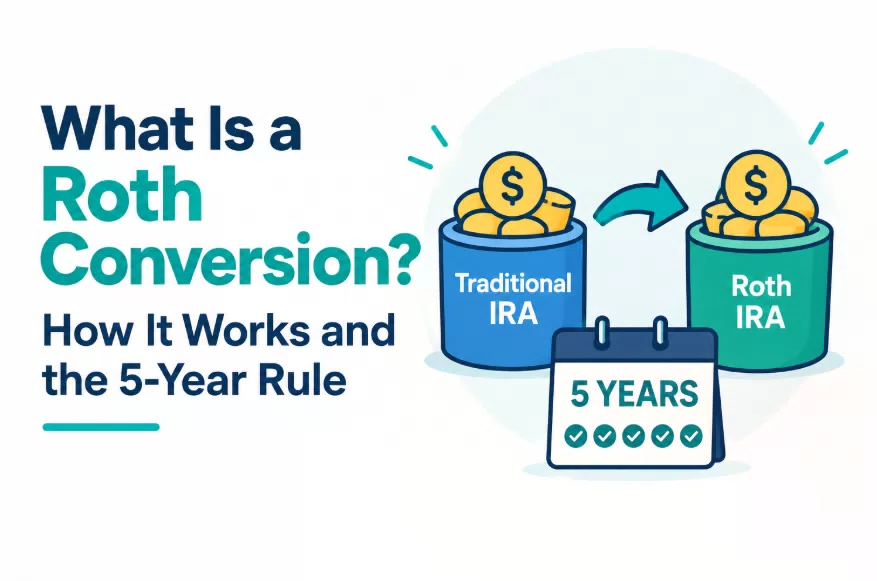
A Roth conversion moves money from a traditional (pre-tax) retirement account into a Roth account, paying income tax on the converted amount now in exchange for tax-free growth and tax-free withdrawals later. It's the reverse trade of the initial tax deduction a traditional account gave you — and once you make it, per IRS rules, you cannot undo it.
The Basic Mechanics
The converted amount is added to your ordinary taxable income for the year of the conversion — there's no separate "conversion tax rate." It's taxed exactly like any other income, at whatever marginal bracket it lands in. If the traditional account you're converting from contains only pre-tax money, the entire converted amount is taxable. If it contains after-tax contributions you never deducted (tracked on Form 8606 as basis), that portion comes out tax-free.
A conversion does not count toward your annual IRA contribution limit — contributions and conversions are tracked entirely separately, so converting $50,000 in a year doesn't use up any of your $7,500 contribution room.
There's no income limit on who can convert, and there never has been since 2010 — a 2005 law eliminated the prior $100,000 income cap on conversions, which is precisely what makes the "backdoor Roth" strategy (a nondeductible traditional contribution immediately converted) possible for high earners who are otherwise blocked from contributing to a Roth IRA directly.
The Decision Is Permanent
Before 2018, you could recharacterize a conversion — essentially undo it, as if it never happened, if markets dropped or your tax situation changed after converting. The Tax Cuts and Jobs Act eliminated that option for any conversion made in 2018 or later, confirmed directly in IRS guidance and Publication 590-A. Once you convert, the tax bill is locked in regardless of what happens to the investment afterward — converting right before a 30% market drop means paying tax on value that's no longer there, with no way to reverse the decision.
The Pro-Rata Rule: You Can't Cherry-Pick Which Dollars Convert
This is the single most misunderstood piece of Roth conversion mechanics, and it's what trips up the backdoor Roth strategy for anyone who already holds pre-tax IRA money.
If you have both pre-tax and after-tax (basis) dollars across your traditional, SEP, and SIMPLE IRAs, the IRS doesn't let you choose to convert only the after-tax portion. Instead, the taxable percentage of any conversion is calculated proportionally across all your combined traditional-type IRA balances — you can't isolate the already-taxed dollars in one account and convert just those.
A Worked Example
Say you have $150,000 combined across your traditional IRAs, of which $30,000 is after-tax basis (nondeductible contributions you've tracked on Form 8606 over the years). That makes your IRAs 80% pre-tax, 20% after-tax overall.
If you convert $20,000:
Taxable portion: $20,000 × 80% = $16,000
Tax-free (basis) portion: $20,000 × 20% = $4,000
This ratio applies no matter which specific IRA account the $20,000 is physically withdrawn from — you can't convert from "the account with the basis in it" and expect the whole $20,000 to come out tax-free. The only common workaround, for someone trying to execute a clean backdoor Roth without pro-rata complications, is rolling existing pre-tax IRA balances into an employer 401(k) that accepts incoming rollovers first — which removes those pre-tax dollars from the pro-rata calculation entirely, since 401(k) balances aren't included in it.
The Two Different "5-Year Rules" — And Why They Get Confused
Roth accounts actually have two separate five-year clocks, and conflating them is one of the most common mistakes people make when researching this topic.
Rule 1: The account-level clock (for tax-free earnings). Growth inside any Roth IRA becomes withdrawable completely tax-free only after the Roth IRA has been open at least five tax years and you're 59½ or older (or meet another qualifying exception). This clock is per person, not per conversion — it starts counting from January 1 of the year of your very first Roth contribution or conversion, ever, and it doesn't reset with each new conversion.
Rule 2: The per-conversion clock (for penalty-free access to converted principal). Separately, each individual conversion carries its own five-year clock specifically for avoiding the 10% early-withdrawal penalty on the converted principal, applicable only if you're under 59½. Withdraw converted funds before that specific conversion's five years are up, while under 59½, and that portion is subject to the 10% penalty — even though you already paid ordinary income tax on it at the time of conversion.
This second rule exists specifically to prevent using conversions as a loophole to access traditional IRA money penalty-free before 59½ by converting and immediately withdrawing. It's also the basis for a strategy sometimes called a Roth conversion ladder — converting a set amount every year for at least five consecutive years, so that a rolling supply of penalty-free converted principal becomes accessible each year going forward, timed for those who want penalty-free access before the standard retirement age.
RMDs and Conversions: What You Can't Do
You cannot convert a required minimum distribution. If you're subject to RMDs, the IRS requires you to take your full RMD for the year first — as an ordinary, taxable distribution — before converting any additional amount from that same account. Only funds remaining after the RMD is satisfied are eligible to be converted.
Why the Window Between Retirement and RMDs Gets So Much Attention
The years after you stop earning a paycheck but before RMDs force withdrawals are frequently highlighted as the most efficient conversion window, because your taxable income during that stretch can be unusually low — sometimes near zero if you haven't yet claimed Social Security and have no other earned income.
A Bracket-Fill Example
Say a retiree has $30,000 in other taxable income for the year and wants to convert as much as possible while staying inside the 12% bracket, which (per the 2026 federal brackets) runs up to $50,400 for a single filer.
Room available in the 12% bracket: $50,400 − $30,000 = $20,400
Tax owed on converting that full $20,400: $20,400 × 12% = $2,448
Effective rate on the converted dollars: exactly 12%
Convert one dollar more than that $20,400, and it spills into the 22% bracket instead — the same bracket-stacking mechanic that applies to any other income. This "fill the bracket, stop at the edge" approach is the core of most professionally recommended conversion strategies: converting a deliberate, calculated amount each year to use up cheap tax brackets while they're available, rather than converting everything at once or waiting until RMDs force much larger, more expensive withdrawals in a single year later.
What a Conversion Can Affect Beyond Your Federal Bracket
The added income from a conversion counts toward Modified Adjusted Gross Income (MAGI) for several purposes beyond your marginal bracket — it can increase how much of your Social Security benefit is taxable (up to 85% becomes taxable at higher income levels), and because Medicare premium surcharges (IRMAA) are based on income from two years prior, a large conversion can raise Medicare Part B and D premiums specifically two years later, even if income drops back down afterward. Both effects are worth modeling before converting a large amount in a single year, rather than looking only at the federal bracket impact.
Should You Use Retirement Funds to Pay the Conversion Tax?
Generally not recommended. Paying the tax bill from the converted account itself means less money actually makes it into the Roth to grow tax-free, and if you're under 59½, the portion used to pay taxes can itself be hit with the 10% early-withdrawal penalty, since it's being distributed rather than converted. Paying the tax from outside savings — cash on hand, not retirement funds — preserves the full converted amount inside the Roth and avoids that extra penalty exposure.
Frequently Asked Questions
Is there a limit to how much I can convert in one year?
No. Unlike contributions, there's no annual dollar cap on conversions — you can convert any amount, including your entire traditional IRA balance, in a single year if you choose to, subject to the tax consequences of doing so.
Does converting affect my Roth IRA contribution limit for the year?
No. Conversions and contributions are tracked separately — converting any amount doesn't reduce or affect your ability to make a regular annual contribution.
Can I convert a 401(k) directly to a Roth IRA?
Often yes, through a rollover, if you're eligible to move funds out of the 401(k) (after leaving the employer, or if the plan allows in-service distributions) — the converted amount is taxed the same way a traditional IRA conversion would be.
Is the backdoor Roth strategy still legal?
Yes — it remains a widely used, IRS-acknowledged approach. The pro-rata rule still applies in full, though, so it works cleanly only for people with no other pre-tax IRA balances, or who've rolled those balances into a 401(k) first.
What happens if I convert and then the investment loses value?
You still owe tax on the amount you converted, calculated at the time of conversion — the tax bill doesn't adjust downward if the investment's value drops afterward, since recharacterization is no longer available to undo the conversion.
Key Takeaways
A Roth conversion is a permanent decision to pay tax now on a traditional retirement balance in exchange for tax-free growth and withdrawals later, taxed as ordinary income in the year it's executed, with no way to reverse it once done. The pro-rata rule prevents cherry-picking which dollars convert tax-free, and two separate five-year clocks — one for tax-free earnings on the account overall, one for penalty-free access to each specific conversion's principal — govern different aspects of when converted or grown funds can actually be touched.
The years between retirement and the start of RMDs are commonly the most tax-efficient window for conversions, since filling up lower brackets during a temporarily low-income stretch — as the worked example above shows — can convert a meaningful amount at a rate far below what RMD-driven income might otherwise force later.
Sources
This article is for general educational purposes only and does not constitute financial, investment, tax, or legal advice.