What Is a Required Minimum Distribution (RMD)? How It's Calculated
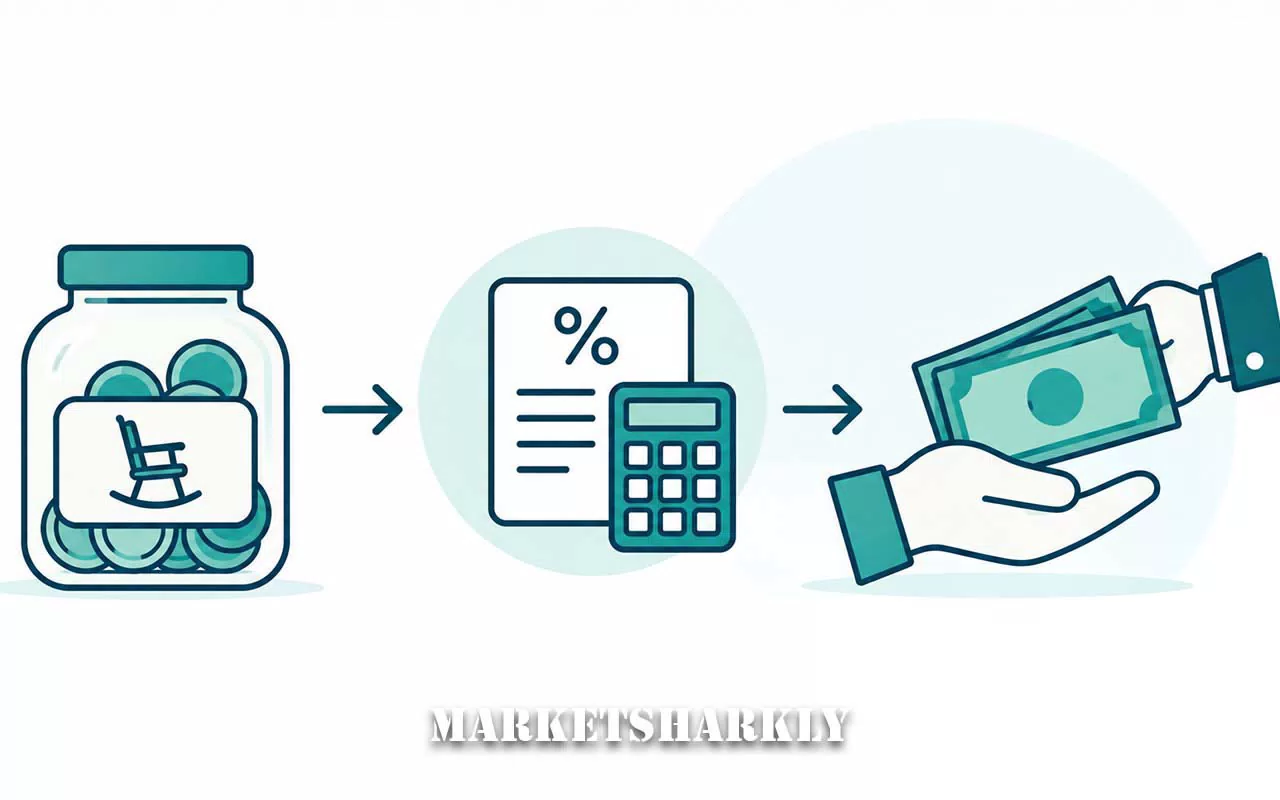
A required minimum distribution is the amount the IRS forces you to withdraw each year from most traditional retirement accounts once you reach a certain age — regardless of whether you actually need the money. It's the government's way of finally collecting tax on decades of tax-deferred growth, and getting it wrong carries one of the steepest percentage penalties anywhere in the tax code.
When RMDs Start
Under the SECURE 2.0 Act, the RMD starting age depends on your birth year:
Age 73 — if you were born between 1951 and 1959
Age 75 — if you were born in 1960 or later, effective starting in 2033
This is the second increase in recent years: the original SECURE Act of 2019 had already moved the age from 70½ to 72, and SECURE 2.0 pushed it further to 73, then eventually 75, phasing in based on birth year rather than taking effect all at once.
The Formula
RMD = Account Balance (as of December 31 of the prior year) ÷ IRS Life Expectancy Factor
The factor comes from the IRS's Uniform Lifetime Table, and it shrinks every year as you age — which means the required percentage of your balance you must withdraw actually rises each year, even if your account value stays perfectly flat.
Age | Life Expectancy Factor | RMD on a $750,000 Balance |
|---|---|---|
73 | 26.5 | $28,302 |
75 | 24.6 | $30,488 |
80 | 20.2 | $37,129 |
At age 73, that $750,000 balance requires withdrawing about 3.77% of it. By 80, the identical balance would require 4.95% — not because you're taking out more money by choice, but because the shrinking divisor mechanically raises the required percentage every single year you stay alive.
A different table applies in one specific situation: if your spouse is your sole beneficiary and is more than 10 years younger than you, the Joint Life and Last Survivor Table is used instead, which produces a lower required withdrawal than the standard table.
The Trap Hiding in the "First RMD" Deadline
Your very first RMD has a special grace period: it isn't due by December 31 of the year you reach your RMD age — you can delay it until April 1 of the following year. That sounds like a benefit, and it can be, but it comes with a catch that surprises a lot of retirees.
Every RMD after the first one is still due by December 31 of its own year. If you use the April 1 extension for your first RMD, you end up taking two RMDs in the same calendar year — the delayed one (due April 1) and that year's regular one (due December 31).
What That Actually Costs
Take that same $750,000 balance, owed as an RMD for the year you turn 73:
RMD for the first year (delayed to April 1 of the following year): ≈ $28,302
RMD for the second year (still due by December 31 of that same year): ≈ $30,000
Total RMD income landing in a single tax year if you delay: ≈ $58,302
That's nearly double the income hitting one tax return, and RMDs are taxed as ordinary income — stacking on top of any other income you have that year, exactly the way the tax bracket mechanics work for any other income. Depending on your other income, that stacked total can push a meaningful portion of the combined RMDs into a materially higher marginal bracket than either RMD would have hit on its own, and can also affect things like how much of your Social Security benefit is taxable or trigger higher Medicare premiums (IRMAA) the following year. The April 1 delay isn't free — it's a timing choice with a real, calculable tax consequence worth running the numbers on before defaulting to it.
The Penalty for Missing One
If you fail to withdraw the full RMD by the deadline, the shortfall is subject to an IRS excise tax of 25% — reduced from a much harsher 50% under prior law, with SECURE 2.0 cutting it further to just 10% if you correct the shortfall within two years. Fixing a missed RMD generally means taking the missed distribution as soon as possible and filing Form 5329 with your return; the penalty can also be waived entirely if you can show the shortfall was due to reasonable error and you're taking steps to correct it.
Which Accounts Require RMDs — and Which Don't
Traditional IRAs, traditional 401(k)s, 403(b)s, and similar pre-tax employer plans are all subject to RMDs during the original owner's lifetime.
Roth IRAs have never had a lifetime RMD requirement for the original owner — the money can stay invested indefinitely.
Roth 401(k)s and Roth 403(b)s were different for years — despite being Roth accounts, they used to carry the same lifetime RMD requirement as their traditional counterparts, a frequently criticized inconsistency. SECURE 2.0 fixed this: starting in 2024, designated Roth accounts in employer plans are no longer subject to lifetime RMDs, aligning them with how Roth IRAs have always worked.
One IRA Account or Five: The Aggregation Rule
If you hold multiple traditional IRAs, you don't need to calculate and withdraw a separate RMD from each one — IRA balances can be aggregated, and you can satisfy the combined total from any single IRA (or any combination) you choose.
401(k) accounts work differently. Each separate 401(k) requires its own RMD calculated and withdrawn from that specific plan — you can't satisfy a 401(k)'s RMD by pulling extra from an IRA, or from a different employer's 401(k). Someone with several old 401(k)s from past employers, alongside IRAs, needs to track this distinction carefully rather than assuming all retirement accounts aggregate the same way.
A Way to Reduce the Tax Hit: Qualified Charitable Distributions
If you're charitably inclined, a Qualified Charitable Distribution (QCD) lets you send IRA funds directly to a qualifying charity, and that amount counts toward satisfying your RMD without being included in your taxable income at all — a meaningfully different outcome than withdrawing the RMD yourself and then separately donating it, since a QCD never shows up as income in the first place. The 2026 QCD limit is $111,000 per individual.
One detail worth knowing: QCD eligibility starts at age 70½, which is earlier than the current RMD starting age of 73. That gap means someone between 70½ and 73 can already use QCDs for their own charitable giving, even though they aren't yet required to take any RMD at all.
The Years Before Your RMDs Start Are a Planning Window
The stretch between when you stop working and when RMDs begin is often highlighted by planners as a strategic opportunity — income in those years may be unusually low compared to your working years or your eventual RMD-driven income, which can make it a relatively efficient window for strategies like converting traditional balances to Roth accounts at a lower tax cost than either your peak earning years or your future, RMD-inflated retirement income would allow. The specific mechanics, trade-offs, and eligibility considerations of a Roth conversion are enough to warrant a full explanation on their own.
Frequently Asked Questions
Can I withdraw more than my RMD?
Yes — the RMD is a floor, not a ceiling. You can always withdraw more than required, though amounts above the RMD generally cannot be rolled over into another retirement account the way certain other distributions can.
Do RMDs apply to inherited retirement accounts?
Generally yes, but the rules for inherited accounts are substantially different from the rules for your own original accounts — timing, calculation method, and available options depend heavily on your relationship to the original owner and current law, which has changed significantly in recent years.
Does converting to a Roth IRA eliminate future RMDs on that money?
Yes — once funds are converted to a Roth IRA, that portion is no longer subject to lifetime RMDs, since Roth IRAs carry no such requirement for the original owner.
What happens to the money once I take an RMD?
It's yours to do with as you choose — spend it, reinvest it in a taxable account, or (if you're eligible and it qualifies) direct it to charity through a QCD. The RMD rule only forces the withdrawal from the tax-deferred account; it doesn't dictate what happens to the money afterward.
Is the RMD age the same for everyone?
No — it depends specifically on your birth year under SECURE 2.0's phased schedule: 73 for those born 1951–1959, and 75 for those born in 1960 or later, once that later provision takes effect in 2033.
Key Takeaways
RMDs force withdrawals from traditional retirement accounts starting at age 73 (or 75 for those born in 1960 or later), calculated by dividing your prior year-end balance by an IRS life expectancy factor that shrinks — and therefore raises your required withdrawal percentage — every year you age. Missing one triggers a steep 25% excise tax on the shortfall, though that drops to 10% if corrected within two years.
The often-overlooked first-year deadline extension can quietly double your taxable income in a single year if you're not accounting for it, and Roth IRAs (along with Roth 401(k)s since 2024) remain the notable exception with no lifetime RMD requirement at all — a distinction worth factoring into which accounts you draw from first once RMDs are part of the picture.
Sources
This article is for general educational purposes only and does not constitute financial, investment, tax, or legal advice.