What Is a HELOC (Home Equity Line of Credit)? How It Works
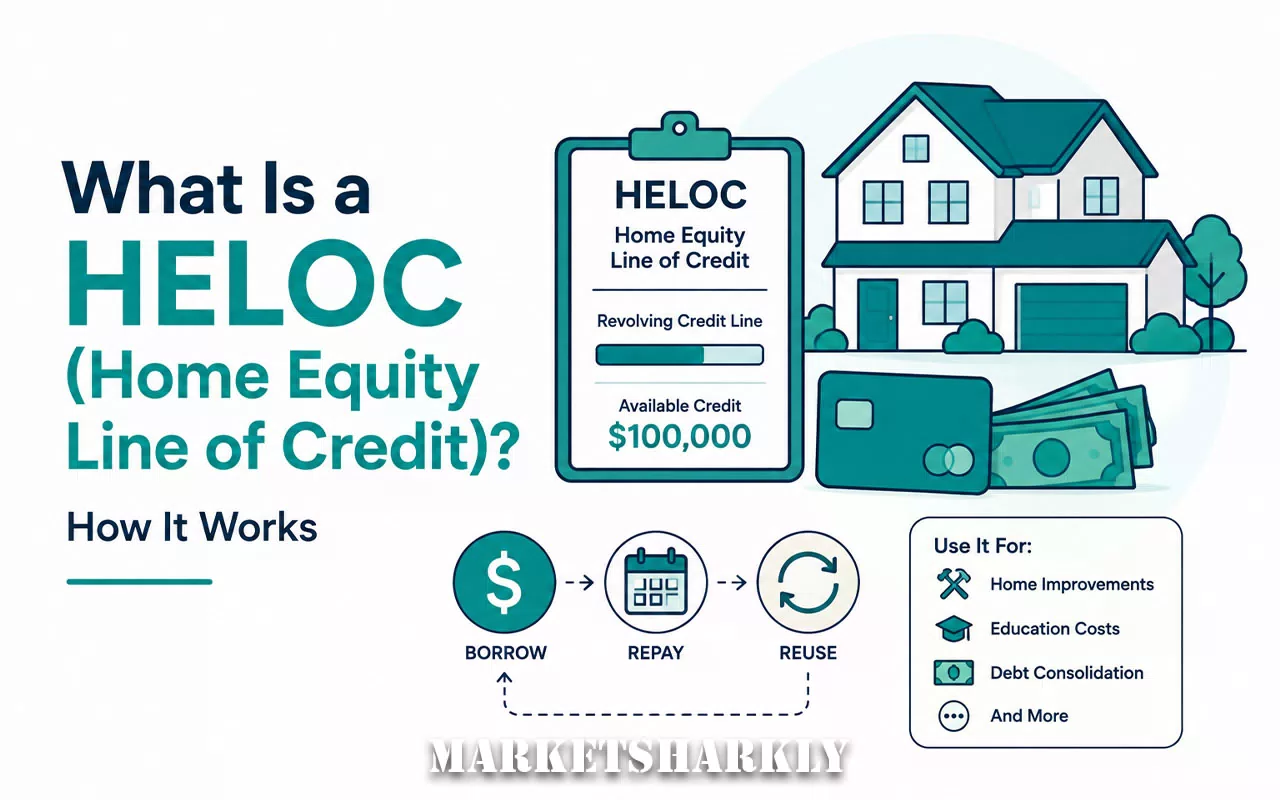
A home equity line of credit, or HELOC, lets you borrow against the equity you've built in your home — not as a single lump sum, but as a revolving credit line you can draw from, repay, and draw from again, similar to a credit card, up to a limit the lender sets. It's secured by your home, which is what makes the rate typically lower than unsecured credit, and also what makes it materially riskier than unsecured debt if you can't keep up with payments.
Draw Period vs. Repayment Period
A HELOC runs through two distinct phases, and the difference between them is the single most important thing to understand before opening one.
The draw period, commonly around 10 years, is when you can actually borrow against the line — writing a check, transferring funds, or using a card tied to the account, depending on the lender. During this phase, many HELOCs only require an interest-only minimum payment: you're paying the interest that's accrued on whatever you've borrowed, without being required to reduce the principal at all.
The repayment period, commonly 10 to 20 years, begins once the draw period ends. You can no longer borrow against the line, and the loan converts to fully amortizing principal-and-interest payments on whatever balance is outstanding — the same interest-front-loaded amortization mechanics that apply to any other amortizing loan.
Why the Transition Often Comes as a Shock
Because draw-period payments often cover only interest, your balance doesn't shrink during that phase unless you voluntarily pay more than the minimum. That means the full balance you've drawn is still sitting there — untouched — right up until the repayment period begins, at which point the payment has to switch to fully paying that balance down within a fixed, comparatively short remaining term.
Here's what that transition can look like in practice. Say you're carrying a $50,000 balance at an 8.5% rate at the end of the draw period.
Interest-only draw period payment: $50,000 × (8.5% ÷ 12) ≈ $354/month
Fully amortizing repayment period payment, over a 20-year repayment term: ≈ $434/month
That's roughly a 22% jump, and it's often larger in practice, since many HELOCs carry a variable rate — meaning the rate itself, not just the payment structure, can also have moved by the time the repayment period starts. The CFPB specifically flags this transition, sometimes called payment shock, as one of the primary risks associated with HELOCs.
How Much You Can Borrow
Lenders base your available HELOC credit line on your home's value, your existing mortgage balance, and a maximum combined loan-to-value (CLTV) ratio the lender sets — commonly somewhere around 80%–85%, though this varies by lender.
For example, on a home worth $400,000 with an existing mortgage balance of $220,000, and a lender's maximum CLTV of 85%:
Maximum total debt allowed: $400,000 × 85% = $340,000
Available HELOC credit line: $340,000 − $220,000 = $120,000
Your actual approved limit can come in below that maximum, since lenders also weigh credit score, income, and other factors — the CLTV calculation sets a ceiling, not a guarantee.
HELOC vs. a Home Equity Loan
A HELOC and a home equity loan both let you borrow against home equity, but the structures are different. A home equity loan gives you a single lump sum upfront at a fixed rate, repaid through fixed installments over a set term from day one — no draw period, no revolving access. A HELOC gives you flexible, repeated access to funds up to a limit during the draw period, typically at a variable rate, with the amortizing repayment structure only kicking in afterward.
If you know exactly how much you need and want payment certainty from the start, a home equity loan's fixed structure looks more like a standard installment loan. If you want ongoing flexible access — for a renovation with costs that come in stages, for example — a HELOC's revolving structure fits that use case more naturally, at the cost of payment predictability.
The Core Risk: Your Home Is the Collateral
A HELOC is secured debt — your home backs the line of credit, which is part of why HELOC rates are typically lower than unsecured options like a personal loan or credit card. The trade-off is that falling behind on a HELOC carries a materially different consequence than falling behind on unsecured debt: it can put your home at risk of foreclosure, not just your credit score.
This is also why a HELOC generally isn't treated as a casual source of funds. It's most commonly used for things tied to real, often home-related value or a defined purpose — home improvements, debt consolidation, or major planned expenses — rather than as an ongoing substitute for a standard credit line.
Frequently Asked Questions
Is a HELOC's rate always variable?
Typically yes, tied to a market index similar to how other variable-rate products work — though some lenders offer the option to convert some or all of a HELOC balance to a fixed rate, either at origination or at a later point, depending on the lender's terms.
Can I still draw funds during the repayment period?
No. Once the draw period ends, borrowing against the line stops, and payments are directed entirely toward paying down the outstanding balance.
What happens if my home's value drops during my HELOC?
It can affect your available credit — some lenders have the ability to reduce or freeze a HELOC's credit limit if the home's value falls enough that the original combined loan-to-value calculation is no longer met.
Is interest on a HELOC tax-deductible?
It depends on how the funds are used and current tax law, which has changed in recent years — this is a question worth directing to a tax professional rather than assuming based on how HELOC interest was treated in the past.
How can I avoid payment shock at the end of the draw period?
Paying more than the interest-only minimum during the draw period, even occasionally, reduces the principal balance you'll be carrying into the repayment period — which lowers both the size of the transition and the total interest paid over the life of the HELOC.
Key Takeaways
A HELOC gives you revolving, credit-card-like access to your home's equity during a draw period — often with low, interest-only payments — followed by a repayment period where the loan converts to a fully amortizing payment on whatever balance remains. The gap between those two payment amounts can be substantial, which is exactly why the CFPB highlights payment shock as a central risk to plan for before opening one.
Because a HELOC is secured by your home, the stakes of falling behind are higher than with unsecured credit — understanding both phases going in, not just the appealing low payment during the draw period, is what separates using a HELOC as an effective tool from being caught off guard by it.
Sources
Consumer Financial Protection Bureau — What You Should Know About Home Equity Lines of Credit
Federal Trade Commission — Home Equity Loans and Home Equity Lines of Credit
This article is for general educational purposes only and does not constitute financial, investment, tax, or legal advice.
Last updated: August 2026