Treasury Bills, Notes, Bonds, and TIPS: How They Differ and How to Choose
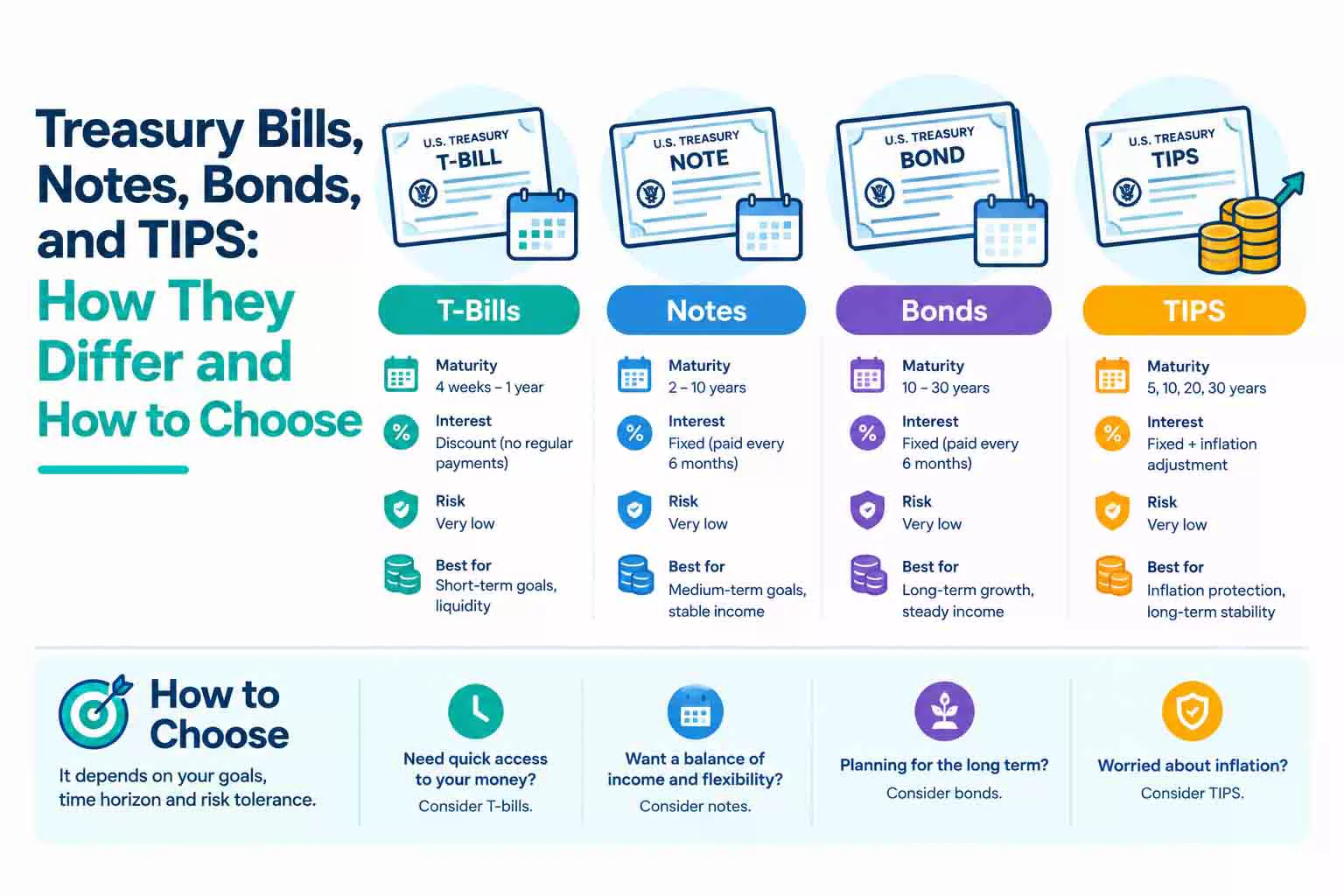
U.S. Treasury securities are often described as the safest investments available, and in one narrow sense that is true: the full faith and credit of the federal government stands behind the interest and principal payments. But "safe" hides a lot of detail. A one-month Treasury bill and a 30-year Treasury bond share the same issuer and almost nothing else about how they behave.
This guide explains the four securities most individual investors encounter (bills, notes, bonds, and TIPS), how each pays you, how they are bought, how they are taxed, and where the real risks sit. A worked example shows why the "discount rate" quoted on a bill understates what you earn, and how much a longer-term bond can lose in price when rates rise.
Nothing here is a recommendation to buy a particular security. Yields change at every auction, so this article deliberately uses hypothetical rates; check current auction results on TreasuryDirect before deciding.
The four securities at a glance
Security | Original terms | How you are paid | Principal |
|---|---|---|---|
Treasury bill | 4, 6, 8, 13, 17, 26, or 52 weeks | One payment at maturity: face value, bought at a discount | Fixed |
Treasury note | 2, 3, 5, 7, or 10 years | Fixed interest every six months, plus principal at maturity | Fixed |
Treasury bond | 20 or 30 years | Fixed interest every six months, plus principal at maturity | Fixed |
TIPS | 5, 10, or 30 years | Interest every six months on an inflation-adjusted principal | Rises and falls with CPI-U |
Two naming points trip people up. First, "Treasury bond" is also used casually for any Treasury, but strictly it means the 20- and 30-year securities. Notes are not "short bonds" in a technical sense; they are a separate category. Second, the savings bonds you may have heard about (such as the I bond covered in a separate article) are a different product family. Marketable Treasuries can be sold to other investors before maturity, while savings bonds cannot.
How you buy them
Treasury sells these securities at auctions. Most individuals bid non-competitively, which means you accept the return set at the auction and are awarded the full amount you ask for, up to $10 million per auction. A competitive bid lets you name a return but risks getting nothing or a partial award if you ask for too much, so it suits larger, more experienced buyers.
You can buy directly at TreasuryDirect, where the Treasury says there are no fees to open an account or buy securities, or through a broker, bank, or dealer in the secondary market. The minimum purchase for bills, notes, bonds, and TIPS is $100, in multiples of $100. Older articles that quote a $1,000 minimum are out of date; the lower minimum took effect in 2008. One limit to know: Cash Management Bills, which Treasury issues irregularly, are not available through TreasuryDirect.
How each security earns money
Bills pay no periodic interest. You pay less than face value and receive the full face value at maturity; the difference is your interest. The auction result is quoted as a discount rate, which is not the same as your actual yield (see the worked example).
Notes and bonds pay a fixed coupon every six months. If you hold to maturity you get every coupon plus your principal back. If you sell early, the market price decides what you receive.
TIPS adjust their principal using the Consumer Price Index for All Urban Consumers (CPI-U). The coupon rate is fixed, but it is applied to the adjusted principal, so interest payments rise with inflation. At maturity you receive the greater of the inflation-adjusted principal or the original principal, which protects you from deflation over the full term. Treasury's auction rules also allow negative real yields.
Taxes: what is and is not exempt
Interest on all Treasury marketable securities is subject to federal income tax but exempt from state and local income tax. For someone in a state with an income tax, that exemption can be worth real money. As a hypothetical, with a 5% state rate, a Treasury yielding 4.00% matches a fully taxable bank product yielding about 4.21% after state tax (4.00 ÷ 0.95), if federal tax treatment is the same.
The TIPS exception: Treasury notes that any increase or decrease in the principal during the year may affect your federal taxes. In a taxable account, the inflation adjustment can therefore create tax owed on money you do not receive in cash until maturity or sale. Holding TIPS in a tax-advantaged account is a common way to sidestep this, a decision worth discussing with a tax professional.
Worked example 1: what a bill discount rate really means
Suppose a 26-week (182-day) bill is auctioned at a 4.00% discount rate, and you buy $10,000 of face value. All figures are hypothetical and were calculated with a script.
Price = $10,000 × (1 − 0.04 × 182 ÷ 360) = $9,797.78
Interest earned = $10,000 − $9,797.78 = $202.22
Return over 182 days = $202.22 ÷ $9,797.78 = 2.064%
Annualized (365-day basis) = 2.064% × 365 ÷ 182 ≈ 4.14%
With the interest reinvested, the effective annual rate is about 4.18%
The 4.00% headline is lower than the 4.14% you actually earn because the discount rate divides by face value (not the lower price you paid) and uses a 360-day year. This is why the investment rate or yield figures Treasury also publishes are the better numbers to compare against a CD or savings account.
Worked example 2: what happens to a long bond when rates rise
Take a hypothetical $10,000 Treasury with a 4% coupon (paid semiannually), bought at par when market yields are 4%. If yields then rise or fall immediately, the market price changes like this:
Market yield | 10-year note price | 30-year bond price |
|---|---|---|
3% | $10,858 | $11,969 |
4% | $10,000 | $10,000 |
5% | $9,221 | $8,455 |
A one-percentage-point rise cuts the 10-year note's price by about 8% and the 30-year bond's by about 15%. If you hold to maturity, you still receive your $10,000 and every coupon, so the loss is only on paper. If you must sell early, you lock it in. That is the real risk behind a "risk-free" Treasury: credit risk is minimal, but interest-rate risk is not.
Worked example 3: the tax drag on TIPS
Assume $10,000 of TIPS with a 1.5% fixed coupon, and CPI-U rises 3% over the first year (the index ratio moves to 1.015 at six months and 1.03 at twelve).
Interest paid: $10,150 × 0.75% + $10,300 × 0.75% = $153.38
Principal adjustment: $10,300 − $10,000 = $300
Taxable amount in a taxable account, if the adjustment is counted that year: about $453
At a hypothetical 24% federal bracket, tax ≈ $109, which is about 71% of the cash actually received
Your $300 gain is real, but you do not collect it until maturity or sale. Plan for that mismatch.
Common misconception: "Treasuries can't lose money"
They can, if you sell before maturity after yields have risen, and TIPS can lose value too if real yields rise. What cannot happen is the government failing to pay what it owes on schedule. The accurate statement is that a Treasury held to maturity pays its promised amount; its market value on any day in between is not guaranteed. Likewise, TIPS are not guaranteed to beat a nominal Treasury; they do better only if inflation exceeds what the market already priced in.
How to choose: matching maturity to the goal
Money needed within a year: bills, so you are not exposed to meaningful price swings.
A known future expense in two to ten years: a note maturing near that date, or a ladder of notes.
Long-term inflation concerns: TIPS, ideally with their tax treatment in mind.
Very long horizons: bonds carry the largest price swings, so size them carefully.
Each of these also interacts with your overall asset allocation and with your emergency fund, topics covered in other articles.
Frequently Asked Questions
1. What is the minimum I can invest in Treasuries? $100, in $100 increments, for bills, notes, bonds, and TIPS.
2. Are Treasury interest payments taxed? Federal income tax applies, but state and local income taxes do not.
3. Can I sell a Treasury before it matures? Yes. Marketable Treasuries can be sold in the secondary market, though the price may be above or below what you paid. Savings bonds cannot be sold this way.
4. What is the difference between TIPS and I bonds? TIPS adjust their principal for inflation and trade on the market; I bonds adjust their interest rate and are purchased only from Treasury. A separate article covers I bonds.
5. Do TIPS protect against deflation? At maturity you receive no less than your original principal, but the principal can fall below par during the term.
Key Takeaways
Bills, notes, bonds, and TIPS differ in term, payment structure, and risk; "Treasury" alone tells you very little.
Minimum purchase is $100, and most individuals bid non-competitively.
Interest is federally taxable and exempt from state and local income tax.
A bill's discount rate understates its true yield; compare using the investment rate.
Long Treasuries are credit-safe but can swing sharply in price when rates move.
TIPS inflation adjustments can create taxable income before you receive the cash.
Sources
TreasuryDirect, Treasury Bills
TreasuryDirect, Treasury Inflation-Protected Securities (TIPS)
TreasuryDirect, FAQs about Treasury Marketable Securities