How Inflation Affects Your Money
How Inflation Affects Your Money
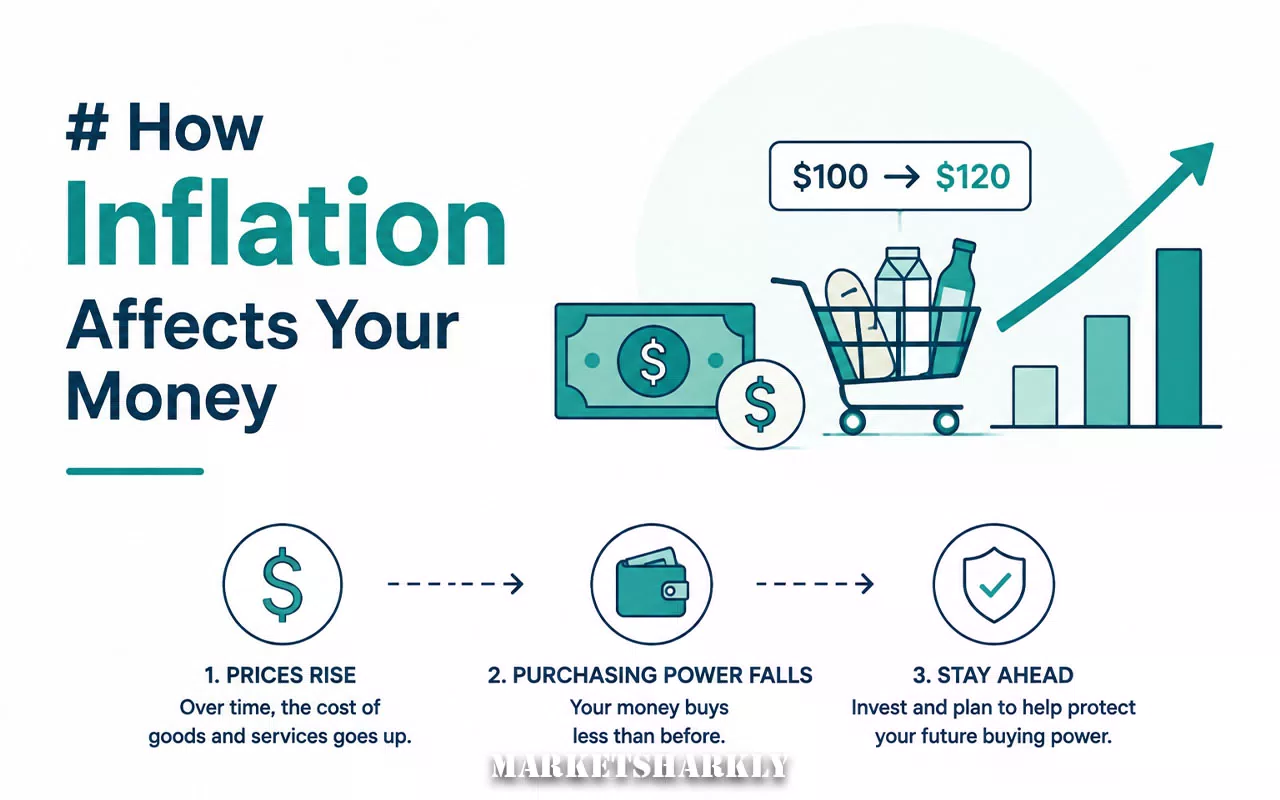
Inflation is the general rise in prices over time, which means the same amount of money buys less than it used to. It's easy to nod along with that definition without feeling its actual effect — which shows up less as a single dramatic event and more as a slow, steady erosion of what your dollars can do, especially for money that isn't earning a return that keeps pace.
How Inflation Is Actually Measured
In the U.S., the primary measure of inflation is the Consumer Price Index (CPI), published monthly by the Bureau of Labor Statistics. CPI tracks the average change over time in prices paid by consumers for a broad basket of goods and services — housing, food, transportation, medical care, and more.
The CPI's practical purpose, in the BLS's own words, is measuring the purchasing power of the consumer's dollar — the value of the goods and services a dollar can buy at different points in time. As prices rise, purchasing power declines by definition; the dollar amount in your pocket or account stays the same, but what it can actually be exchanged for shrinks.
What "Purchasing Power" Actually Looks Like
The clearest way to see inflation's effect is to ask: how much would it cost, in the future, to buy what $100 buys today?
At a steady 3% annual inflation rate:
Years From Now | Cost of Today's $100 Basket |
|---|---|
10 | $134.39 |
20 | $180.61 |
30 | $242.73 |
Nothing about the goods themselves changed in this example — same basket, same quantity. What changed is how many dollars it takes to buy it. Flip that around, and it means $100 held today, left completely idle, would only be able to buy what $74.41 buys today after 10 years of 3% inflation, what $55.37 buys after 20 years, and so on — money that isn't growing is quietly losing ground the entire time.
Why This Matters for Money Sitting Still
Cash sitting in a non-interest-bearing account, or in physical cash, doesn't get any inflation protection at all — its purchasing power simply erodes at whatever the inflation rate happens to be. Even an interest-bearing account isn't automatically safe from this effect; it depends on whether the rate you're earning outpaces inflation.
This is the idea behind the distinction between a nominal return (the plain interest rate or investment return you see quoted) and a real return (what that return is actually worth after subtracting the effect of inflation). A savings account paying 4% APY sounds like straightforward growth, but if inflation is running at 3% over that same period, the real, purchasing-power-adjusted growth is closer to 1% — not 4%. That distinction between nominal and real returns comes up constantly in personal finance and deserves its own full explanation, but the short version is this: any return has to be compared against inflation, not evaluated in isolation, to know what it actually did for your purchasing power.
How Inflation Affects Debt
Inflation doesn't only work against you — it can work in a borrower's favor under certain conditions.
If you're repaying a loan at a fixed interest rate, your required payment stays the same in nominal dollar terms no matter what happens to prices elsewhere in the economy. If wages and prices rise due to inflation while your fixed mortgage or loan payment doesn't, that fixed payment becomes a smaller share of your income over time — effectively cheaper in real terms, even though the dollar figure hasn't moved.
This dynamic doesn't apply the same way to variable-rate debt, since the rate on that kind of loan can adjust in response to the same economic conditions driving inflation in the first place, which can offset some or all of that advantage.
How Inflation Affects Different Kinds of Assets
Different asset types respond to inflation differently, which is part of why diversifying across asset classes matters for long-term financial planning.
Cash and low-yield savings tend to lose the most ground during periods of meaningful inflation, since their returns often lag behind rising prices.
Bonds, particularly longer-term fixed-rate bonds, can also lose real value during unexpected inflation, since their fixed interest payments buy less over time even though the payments themselves don't change.
Stocks have historically provided some longer-term protection against inflation, since company revenues and, over time, prices for the goods and services companies sell can rise along with broader inflation — though stock returns are far from guaranteed or immune to inflation's effects in any given period.
Real assets — real estate, commodities — are sometimes specifically discussed as inflation hedges, since their prices can move with, or ahead of, broader price levels, though each carries its own distinct risks unrelated to inflation.
None of this means any one asset class is a perfect inflation hedge; it means different assets carry different degrees of exposure to inflation's effects, which is one factor among several that goes into an asset allocation decision.
Why the Federal Reserve Targets Inflation, Rather Than Eliminating It
It might seem like zero inflation would be ideal, but the Federal Reserve doesn't target zero — it targets a low, positive rate, commonly cited around 2% annually. A small, steady, predictable amount of inflation is generally viewed as healthier for an economy than either high, unpredictable inflation or its opposite, deflation (falling prices), which can create its own set of problems, including delayed spending and investment.
This is also why "no inflation at all" isn't really the benchmark most financial planning is built around — the more realistic and useful benchmark is whether your income, savings, and investments are keeping pace with whatever inflation actually is, not whether inflation exists at all.
Frequently Asked Questions
Does inflation affect everyone equally?
No. The impact depends heavily on how someone's income, debt, and assets are structured — someone holding mostly cash is affected differently than someone with significant fixed-rate debt or stock market investments, and rising prices don't hit every category of good or service at the same rate.
Is inflation always bad?
Not inherently — a low, stable rate of inflation is generally considered a normal, even healthy, feature of a functioning economy. High or unpredictable inflation, or its opposite (deflation), tends to be more disruptive than a steady, modest rate.
How can I check the current inflation rate?
The Bureau of Labor Statistics publishes CPI data monthly, which is the most widely referenced official source for current U.S. inflation figures.
Does a raise always mean I'm getting ahead of inflation?
Not automatically. If your raise is smaller than the inflation rate over the same period, your real (inflation-adjusted) income has actually declined even though your nominal paycheck went up.
Is my money safe from inflation in a savings account?
It depends on the account's rate relative to inflation. If the account's APY is higher than the inflation rate over the same period, your real purchasing power still grows, just more slowly than the nominal rate suggests; if the APY is lower than inflation, purchasing power erodes even as the account balance rises.
Key Takeaways
Inflation is the ongoing rise in prices, measured in the U.S. primarily through the CPI, and its core effect is a steady erosion of purchasing power — the same dollar buys less over time. That effect touches nearly every part of personal finance: cash and low-yield savings are the most exposed, fixed-rate debt can become relatively cheaper over time, and different investment assets carry different degrees of inflation exposure.
The practical takeaway isn't to fear inflation as an isolated threat, but to evaluate any return, raise, or interest rate against it — a nominal number on its own doesn't tell you whether you're actually gaining ground.
Sources
This article is for general educational purposes only and does not constitute financial, investment, tax, or legal advice.
Last updated: August 2026