How Compound Interest Works (and Why Time Matters More Than Rate)
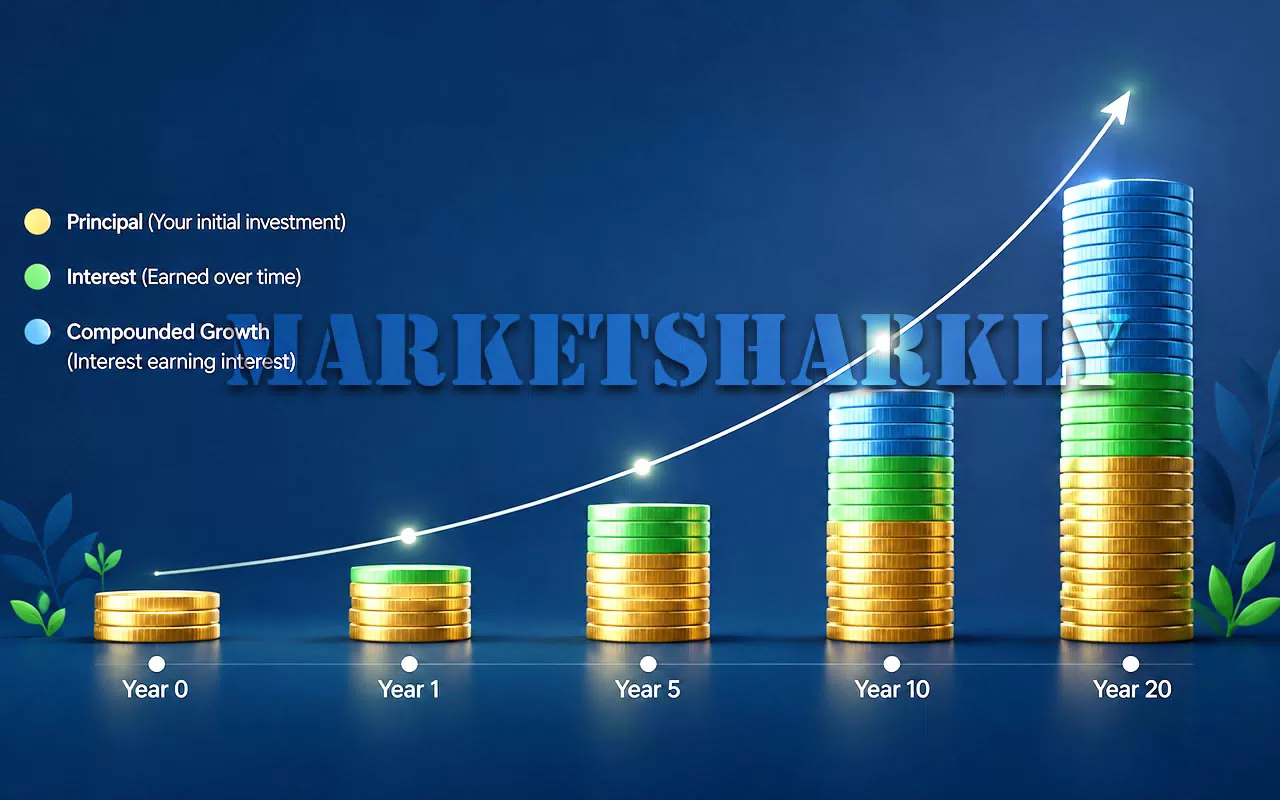
Compound interest is one of the most important concepts to understand when you're saving money or looking at how a balance can grow over time.
The idea itself is simple: you earn interest on your original money, and the interest that accumulates can then become part of the balance used to calculate future interest.
That creates a cycle in which the balance grows, the interest calculation gets larger, and the amount of interest earned can increase from one period to the next.
The same principle can also work against you with certain types of debt.
So how does compound interest actually work? What is the formula? And how much difference can compounding make?
Let's break it down.
What Is Compound Interest?
Compound interest is interest calculated on the principal plus accumulated interest.
The SEC's Investor.gov defines compound interest as interest paid on both principal and accumulated interest.
Here's a simple example.
Suppose you deposit $1,000 into an account earning 5% annually.
After the first year:
$1,000 × 5% = $50
Your balance becomes:
$1,050
During the second year, you're no longer starting with $1,000.
You're starting with $1,050.
So:
$1,050 × 5% = $52.50
Your balance becomes:
$1,102.50
The additional $2.50 comes from earning interest on the $50 of interest accumulated during the first year.
That's the basic idea behind compound interest.
The Consumer Financial Protection Bureau uses essentially this same $1,000-at-5% example to explain how the balance changes from $1,000 to $1,050 and then to $1,102.50.
How Compound Interest Builds Over Time
Using the same $1,000 balance and a constant 5% annual rate:
Year | Starting Balance | Interest | Ending Balance |
|---|---|---|---|
1 | $1,000.00 | $50.00 | $1,050.00 |
2 | $1,050.00 | $52.50 | $1,102.50 |
3 | $1,102.50 | $55.13 | $1,157.63 |
4 | $1,157.63 | $57.88 | $1,215.51 |
5 | $1,215.51 | $60.78 | $1,276.28 |
The interest rate stays at 5% throughout the example.
Yet the amount of interest increases:
Year 1: $50.00
Year 2: $52.50
Year 3: $55.13
Year 4: $57.88
Year 5: $60.78
Why? Because the balance used to calculate the interest keeps getting larger.
The Compound Interest Formula
The standard compound interest formula is:
A = P(1 + r/n)^(nt)
The variables mean:
A = final amount
P = original principal
r = annual interest rate expressed as a decimal
n = number of compounding periods per year
t = number of years
For example, suppose you start with:
$5,000
6% annual interest
Annual compounding
10 years
The calculation is:
A = 5,000 × (1 + 0.06/1)^(1 × 10)
The result is approximately:
$8,954
That means the hypothetical growth is approximately:
$8,954 − $5,000 = $3,954
This calculation assumes the rate remains constant and ignores taxes, fees, deposits, and withdrawals. It is a mathematical example rather than a guaranteed return.
Why the Balance Gets Larger
The important thing about compound interest isn't that the interest rate changes. The rate can remain exactly the same.
What changes is the amount to which the rate is applied.
With a 5% annual rate:
$1,000 → $50 interest
But once the balance reaches $1,050:
$1,050 → $52.50 interest
And when the balance reaches $1,102.50:
$1,102.50 → $55.13 interest
The percentage hasn't changed. The balance has. That is why compound growth can accelerate over time.
What Is Compounding Frequency?
Compounding frequency refers to how often interest is calculated and added to the balance.
Common frequencies include:
Annually
Semi-annually
Quarterly
Monthly
Daily
The more frequently interest compounds, the more opportunities there are for accumulated interest to become part of the balance during the year.
For example, suppose $10,000 earns a hypothetical 6% annual rate for 10 years.
Approximate results are:
Compounding Frequency | Balance |
|---|---|
Annually | $17,908 |
Semi-annually | $18,061 |
Quarterly | $18,140 |
Monthly | $18,194 |
Daily | $18,220 |
The exact treatment of interest depends on the financial product and its terms.
It's also important not to focus only on the word "daily." A higher compounding frequency doesn't automatically make one financial product better than another. The interest rate, fees, account terms, and other conditions also matter.
The CFPB specifically identifies compounding frequency as one of the variables that can affect how quickly savings grow.
What Happens When You Leave Money Alone?
You don't necessarily need to make additional deposits for compound interest to occur.
Suppose you start with $10,000, earn a hypothetical 7% annually, and make no additional deposits or withdrawals.
With annual compounding:
Time | Approximate Balance |
|---|---|
5 years | $14,026 |
10 years | $19,672 |
20 years | $38,697 |
30 years | $76,123 |
40 years | $149,745 |
The example assumes the 7% rate remains unchanged for the entire period.
Real financial products and investments can behave very differently. Interest rates may change, investments can lose value, and fees and taxes can reduce the amount you ultimately receive. The table is simply an illustration of what happens when a constant rate is mathematically compounded over time.
What Happens When You Add Money Regularly?
Compound interest can also be combined with regular contributions.
Imagine starting with $5,000 and adding $200 every month.
Your eventual balance would consist of:
Your original $5,000
The contributions you make
The interest generated by the money in the account
The timing of those contributions matters. Money deposited earlier has more time to potentially generate additional interest than money deposited later.
This is why calculators that include regular contributions can produce very different results from calculations based only on an initial deposit.
Investor.gov's compound interest calculator, for example, allows users to enter an initial investment, monthly contribution, time period, estimated interest rate, and compounding frequency.
Compound Interest and Inflation
A growing balance doesn't automatically mean your purchasing power is growing by the same amount.
Suppose your money earns a nominal 5% while inflation averages 3%.
A simplified inflation-adjusted return can be calculated as:
(1.05 ÷ 1.03) − 1 ≈ 1.94%
So the nominal growth is 5%, while the approximate real growth in purchasing power is 1.94%.
This distinction becomes increasingly important when you're looking at long-term financial goals. A future balance may contain more dollars while those dollars have less purchasing power than they do today.
Compound Interest Can Work Against You
Compound interest isn't inherently good or bad. It's a mathematical process.
When you're earning interest, it can help your balance grow. When you're paying interest, certain forms of compounding can increase the amount you owe.
Credit card debt is an important example to understand, although the exact calculation depends on the card's terms.
The basic principle remains the same: when accumulated amounts become part of the balance used for future calculations, growth can build on previous growth. That's why understanding the terms of a debt product matters just as much as understanding a savings product.
The Main Factors That Affect Compound Growth
Several variables determine the result of a compound-interest calculation.
Starting Balance
A larger initial amount gives the calculation a larger base.
Interest Rate
A higher rate generally produces more growth when all other assumptions are identical.
Time
More periods give the compounding process more opportunities to operate.
Additional Contributions
Regular deposits increase the amount of money that can potentially generate future interest.
Compounding Frequency
Changing how often interest compounds can affect the final result, although the difference may be relatively modest compared with changes in the rate or time period.
Compound Interest vs. Investment Returns
A compound-interest calculation usually assumes a fixed rate. Real investments don't necessarily work that way.
An investment might gain 10% one year and lose 5% the next. Because investment returns fluctuate, you shouldn't interpret a compound-interest calculation using a fixed rate as a prediction of future investment performance.
Actual results can also be affected by:
Investment losses
Fees
Taxes
Withdrawals
Changing interest rates
Dividends or distributions
The SEC's Investor.gov resources likewise distinguish mathematical compounding from the uncertainty involved in actual investing.
A Simple Long-Term Example
Suppose you begin with $2,000 and hypothetically earn 5% annually for 15 years, with annual compounding and no additional contributions.
The formula is:
A = 2,000 × (1.05)^15
The result is approximately:
$4,158
The original $2,000 generated approximately $2,158 in growth.
Again, the purpose of this example isn't to predict what a real investment will earn. It's to show what happens mathematically when a balance repeatedly earns a return and the accumulated amount remains in the calculation.
Frequently Asked Questions
What does compound interest mean?
Compound interest means that interest can be calculated on both the original principal and previously accumulated interest.
What is the compound interest formula?
The standard formula is A = P(1 + r/n)^(nt). It accounts for the starting principal, annual rate, compounding frequency, and time.
Does compound interest happen automatically?
Not necessarily. It depends on the financial product. Some accounts add interest to the balance, while others may pay interest separately. The product's terms determine how the interest is handled.
Is daily compounding always better?
Not necessarily. More frequent compounding can produce a somewhat higher result when other assumptions are identical, but the difference may be relatively small. The interest rate and other terms should also be considered.
Can compound interest apply to debt?
Yes. Depending on the terms of the debt, accumulated interest or other amounts can affect the balance used for subsequent calculations.
Does compound interest guarantee that money will grow?
No. A fixed-rate calculation is simply a mathematical model. Actual financial products and investments can involve changing rates, losses, fees, taxes, and other factors.
Why is compound interest important?
Because accumulated interest can itself generate additional interest. Over many periods, this can create a substantial difference in the final balance.
Key Takeaways
Compound interest is the process of earning interest on a balance that includes previously accumulated interest.
The standard formula is:
A = P(1 + r/n)^(nt)
The result depends on:
Starting balance
Interest rate
Time
Compounding frequency
Additional contributions
The central idea is simple:
Interest increases the balance → the larger balance generates more interest → the process continues.
Over a short period, the difference may be modest. Over many years, the cumulative effect can become much larger.
Understanding that mechanism gives you a useful foundation for evaluating savings accounts, deposits, debt, and other financial calculations.
Sources
Consumer Financial Protection Bureau — How Does Compound Interest Work?
U.S. Securities and Exchange Commission — Compound Interest Calculator
This article is for general educational purposes only and does not constitute financial, investment, tax, or legal advice.
Last updated: August 2026