Fixed-Rate vs. Variable-Rate Loans
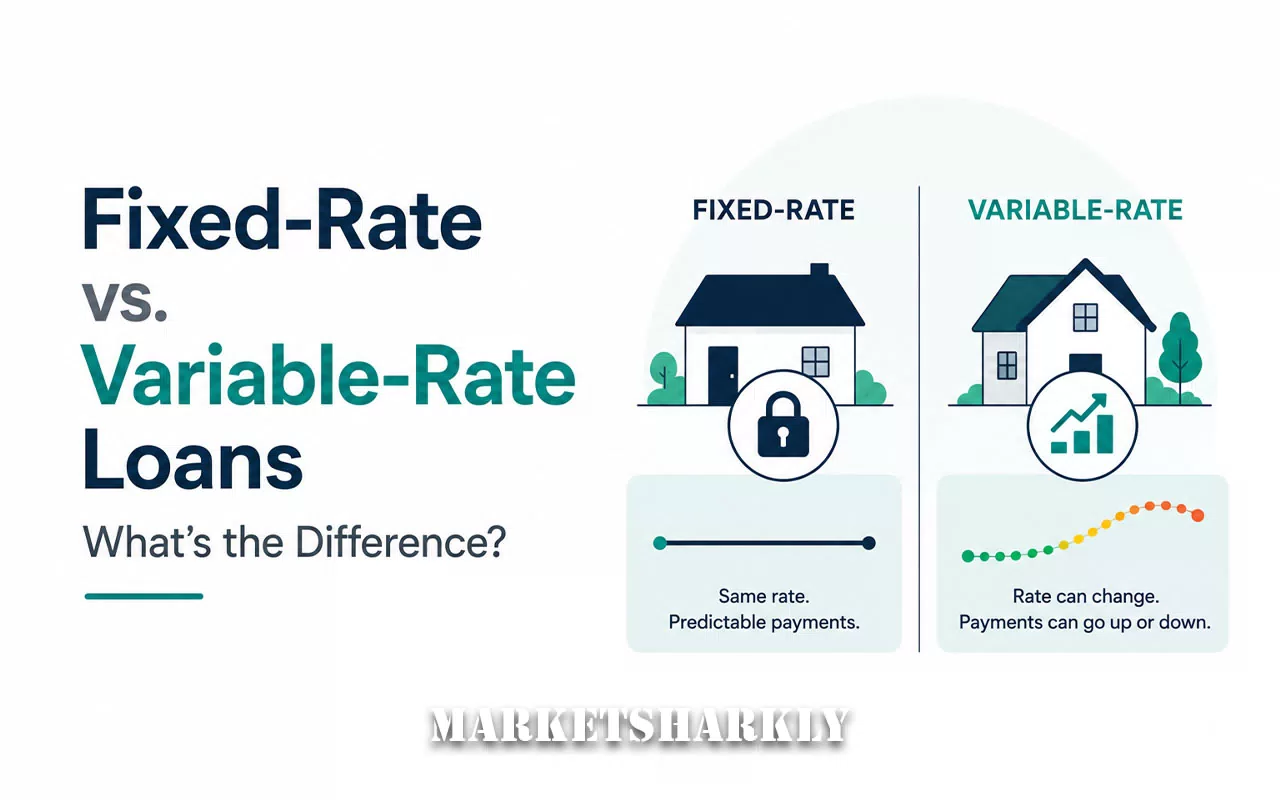
Almost every loan you'll encounter — a mortgage, a personal loan, a private student loan — falls into one of two categories based on how its interest rate behaves over time. A fixed-rate loan locks in one rate for the life of the loan. A variable-rate loan (also called adjustable-rate) starts with a rate that can change on a set schedule, moving your payment up or down along with it.
Neither type is universally better. The right one depends on how long you'll hold the loan, how much payment uncertainty you're willing to accept, and where interest rates seem to be heading.
Fixed-Rate Loans
With a fixed-rate loan, the interest rate is set when you take out the loan and stays the same for the entire term. Your principal-and-interest payment doesn't change from the first payment to the last, which makes long-term budgeting straightforward — you know exactly what you'll owe every month for the life of the loan.
The trade-off is that a fixed rate is generally priced higher at the outset than a comparable variable rate's introductory period, because the lender is the one absorbing the risk that rates might rise later. You're paying for certainty upfront.
Variable-Rate Loans
A variable-rate loan — most commonly seen as an adjustable-rate mortgage, or ARM — usually starts with a fixed introductory rate for a set number of years (commonly three, five, seven, or ten), typically lower than a comparable fixed-rate loan's rate. Once that introductory period ends, the rate adjusts on a regular schedule, often every six or twelve months, based on a market index plus a margin set by the lender.
The index is a benchmark interest rate that moves with broader market conditions — the Secured Overnight Financing Rate (SOFR) is a common one for current ARMs. The margin is a fixed number of percentage points the lender adds on top of the index, and unlike the index itself, the margin doesn't change for the life of the loan.
An ARM is usually labeled with two numbers, like "5/1" or "7/6" — the first number is how many years the introductory rate holds, and the second is how often (in years, or as a fraction of a year for values under 1) the rate adjusts after that. A 5/1 ARM holds its initial rate for five years, then adjusts once a year afterward. A 7/6 ARM holds for seven years, then adjusts every six months.
Rate Caps: The Guardrails on a Variable Rate
Because an adjustable rate can move in either direction, most ARMs include rate caps that limit how much the rate can increase:
An initial adjustment cap limits how much the rate can rise at the very first adjustment after the introductory period ends.
A subsequent adjustment cap limits how much it can rise at each adjustment after that.
A lifetime cap limits the total increase over the entire life of the loan, regardless of how high the underlying index climbs.
These caps mean an ARM's rate can't jump without limit even in a fast-rising rate environment, but the caps still allow for a real increase — sometimes a significant one — so it's worth understanding your specific loan's cap structure rather than assuming the worst case is minor.
A Side-by-Side Payment Example
Take a $300,000, 30-year loan and compare a fixed rate against a 5/1 ARM.
Fixed at 7%: monthly principal-and-interest payment of about $1,996, unchanged for all 30 years.
5/1 ARM starting at 5.5%: monthly payment of about $1,703 for the first five years — noticeably lower than the fixed option. After five years, assume the rate adjusts up to 8.5% (within a typical cap structure) on the roughly $277,000 remaining balance. The new payment over the remaining 25 years comes out to about $2,234 — an increase of over $500 a month from where the ARM started.
That's the trade-off in concrete terms: lower payments during the introductory years, with real exposure to a materially higher payment afterward if rates move against you. If rates had instead stayed flat or fallen by the adjustment date, the ARM borrower could have ended up paying less overall than the fixed-rate borrower for those years. Both outcomes are genuinely possible — that uncertainty is the entire point of the comparison.
Where You'll See Each Type
Fixed rates are the default structure for most personal loans, auto loans, and federal student loans, and they're also the most common mortgage structure in the U.S., typically written as 15-year or 30-year terms.
Variable rates show up most often in ARMs, some private student loans, HELOCs (home equity lines of credit), and certain credit products where the rate is explicitly tied to a moving index.
When Each One Tends to Make Sense
A fixed rate tends to fit:
Borrowers planning to keep the loan for a long time, well past any introductory period a variable rate might offer
Anyone who wants payment certainty for budgeting, regardless of what happens to broader rates
Situations where current rates are relatively low and locking one in looks attractive
A variable rate tends to fit:
Borrowers who plan to sell the property or refinance before the introductory period ends
Situations where the lower introductory payment meaningfully helps with near-term affordability
Borrowers comfortable with — and financially able to absorb — the possibility of a higher payment later
The CFPB's core guidance on this is to make sure you could still afford the loan at its highest possible payment under the cap structure, not just at the introductory rate — since assuming you'll sell or refinance before the adjustment isn't guaranteed, and your financial situation or the property's value could change in the meantime.
Frequently Asked Questions
Can a variable rate ever go down?
Yes. Because the rate is tied to a market index, it can adjust downward as well as upward if the index falls, not just rise.
Is the margin on an ARM negotiable?
It can vary based on your credit profile and the lender, similar to how a fixed rate itself is priced, but once it's set in your loan documents, it doesn't change for the life of the loan — only the index portion moves.
What happens if I can't afford my ARM after it adjusts?
This is exactly the risk the CFPB warns borrowers to plan for in advance. Options can include refinancing into a fixed-rate loan before the adjustment, but refinancing isn't guaranteed to be available or affordable when you need it, which is why affordability at the maximum possible rate is worth checking upfront.
Do all ARMs work exactly the same way?
No. The index used, the margin, the length of the introductory period, and the specific cap structure all vary by lender and loan program, including differences between conventional ARMs and government-backed ones. The details of a specific ARM come from its loan documents, not a single universal formula.
Is a fixed rate always the "safer" choice?
It's the more predictable choice, since your payment can't increase. Whether that's worth the typically higher starting rate depends on your specific timeline and risk tolerance — an ARM isn't inherently reckless, especially for someone who's confident they won't hold the loan past the introductory period.
Key Takeaways
A fixed-rate loan trades a higher starting rate for a payment that never changes. A variable-rate loan trades payment certainty for a typically lower introductory rate, with the risk — bounded by caps, but real — that your payment rises once the introductory period ends and the rate starts tracking a market index plus margin.
Neither structure is objectively better; the right one depends on how long you expect to hold the loan and whether you can comfortably absorb the highest payment your specific loan's cap structure allows, not just the payment you'd have on day one.
Sources
This article is for general educational purposes only and does not constitute financial, investment, tax, or legal advice.
Last updated: August 2026