Debt Snowball vs. Debt Avalanche: Which Payoff Method Really Wins?
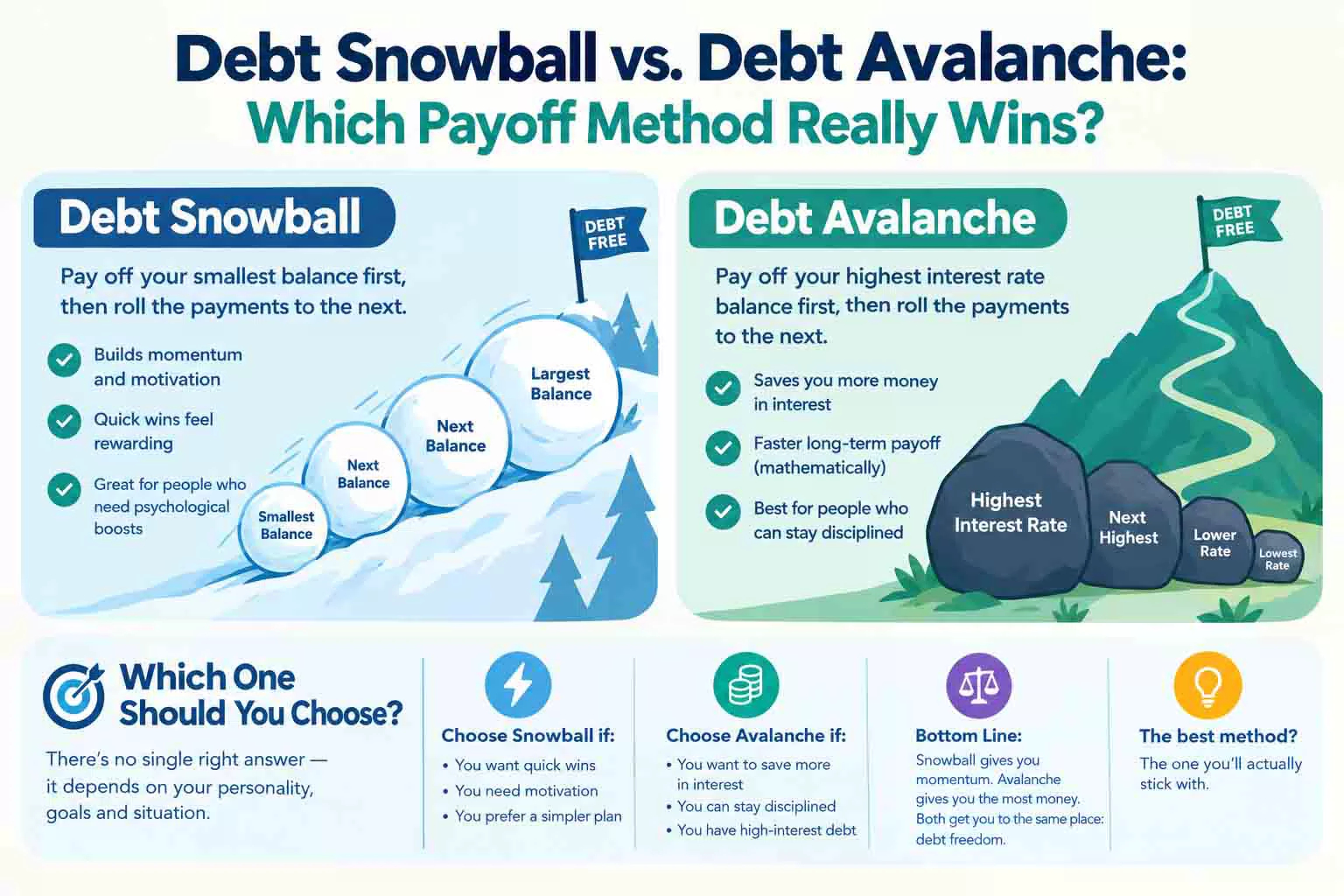
If you owe money on several cards or loans, the question "which one should I pay off first?" has two famous answers. The debt avalanche says to attack the highest interest rate first. The debt snowball says to wipe out the smallest balance first. Each has passionate defenders, and each is often presented as the obvious right choice.
The honest answer is less dramatic. Avalanche usually costs less in interest, but the gap is often smaller than people expect, and a method you abandon in month four saves nothing. This guide explains how both work, runs a full month-by-month comparison on the same four debts, and shows which variable matters more than the method you pick.
This article covers general principles for unsecured consumer debt. It is not a recommendation for any particular situation, and federal student loans and secured loans have features that deserve separate treatment.
What the two methods have in common
Both methods rest on the same mechanics, which is why they are closer cousins than their fans suggest:
Pay the minimum on every debt, every month, so nothing goes delinquent.
Choose one target debt and send every spare dollar to it.
When the target is paid off, roll its payment forward onto the next target. The amount you pay each month in total never shrinks.
The only difference is step 2: how you pick the target. Avalanche ranks debts by interest rate, highest first. Snowball ranks them by balance, smallest first. The "snowball" effect (a growing payment aimed at one debt at a time) exists in both methods, which is a common source of confusion.
How each method works
Avalanche | Snowball | |
|---|---|---|
Target order | Highest APR to lowest | Smallest balance to largest |
Main strength | Lowest total interest in most cases | Quick early wins, fewer accounts sooner |
Main weakness | First payoff can take a long time | Can pay more interest overall |
Best for | People motivated by numbers | People who need visible progress |
The Consumer Financial Protection Bureau has described the same trade-off: focusing on the highest rate eliminates your costliest debt first and can save money, while the smallest-balance approach shows progress quickly but may cost more in the long run.
Why the interest rate matters so much now
Credit card debt is usually the most expensive debt people carry. The Federal Reserve's G.19 consumer credit release reports average credit card APRs of roughly 21% across all accounts and about 22% on accounts that were assessed interest, in its recent 2026 releases. Personal and auto loans are often far cheaper. When rates differ this much, ordering the payoff can matter. When your debts all carry similar rates, ordering barely matters at all.
Worked example: four debts, one monthly budget
All figures are hypothetical and were computed with a script. Interest accrues monthly at APR ÷ 12, and I hold each minimum payment fixed (real card minimums shrink as balances fall, so treat this as a simplified model).
Debt | Balance | APR | Minimum |
|---|---|---|---|
Store card | $1,200 | 29.99% | $35 |
Card A | $4,800 | 24.99% | $110 |
Card B | $2,500 | 17.99% | $65 |
Personal loan | $7,500 | 11.50% | $210 |
Total | $16,000 | $420 |
The person can put $900 per month toward debt in total, which is the $420 in minimums plus $480 extra.
Payoff order
Snowball: Store card ($1,200), Card B ($2,500), Card A ($4,800), Loan ($7,500)
Avalanche: Store card (29.99%), Card A (24.99%), Card B (17.99%), Loan (11.50%)
Notice the first target is identical. The smallest debt also has the highest rate, so both methods begin the same way.
Results
Snowball | Avalanche | |
|---|---|---|
Store card paid off | Month 3 | Month 3 |
Card B paid off | Month 7 | Month 15 |
Card A paid off | Month 15 | Month 11 |
Debt-free | Month 21 | Month 21 |
Total interest paid | $2,427 | $2,305 |
Avalanche saves about $122, roughly 5% of the interest. Both finish in 21 months. Snowball eliminated a second account four months sooner (month 7 versus month 11 for the avalanche's second payoff), which is the "win" its supporters value.
The variable that matters more: your total payment
Now hold the method constant (avalanche) and change only the monthly budget:
Total monthly payment | Months to debt-free | Total interest |
|---|---|---|
$600 | 34 | $4,083 |
$900 | 21 | $2,305 |
$1,200 | 15 | $1,646 |
Moving from $600 to $900 per month saves about $1,778 in interest, and that is more than 14 times larger than the $122 gap between the two methods at $900. In this example, finding an extra $300 a month matters far more than choosing the "correct" method. The same pattern held when I tested the snowball at each budget level: the method gap stayed between about $80 and $220.
When does the gap get large? When a big balance carries a high rate while a small balance carries a low one. If a $900 balance at 9% sits beside a $9,000 balance at 29%, a snowball would leave the expensive debt untouched for a long time.
What most guides get wrong
The usual framing is "avalanche is mathematically correct, snowball is for people who can't handle math." The evidence is more interesting. Researchers who studied how people with two credit cards actually allocate payments found that, after minimums, the cost-minimizing approach would put nearly all extra money (about 97%) on the higher-rate card, but people on average put roughly half there. Most borrowers don't follow either method; they spread payments across several balances.
That means the real comparison is not snowball against avalanche. It is any concentrated strategy against spreading money thinly. Concentrating on one target at a time is the part that works. Which target you choose is the smaller choice.
Choosing between them (or blending them)
Choose avalanche if the rate gaps are wide, your largest balances are also your most expensive, and you trust yourself to stay with a payoff that may take a year to show its first win.
Choose snowball if you have several small debts and juggling them stresses you, or if you've started and quit before. A method you finish beats a method you drop.
Blend them. Some people knock out one or two tiny debts first to cut the number of accounts, then switch to highest-rate-first. Confirm that the small debts aren't far cheaper to leave alone.
Check for features that change the math: promotional or deferred-interest periods, prepayment penalties, and loans with special protections (such as federal student loans) shouldn't be ranked by APR alone.
Related topics, including how credit card interest accrues and how minimum payments work, are covered in separate articles.
Frequently Asked Questions
1. Which method is cheaper? The avalanche is usually cheaper or equal. If the smallest balance also has the highest rate, the two methods can be identical.
2. Which is faster? Total time can be the same, as in the example. The snowball typically clears accounts sooner, while the avalanche often clears dollars of interest sooner.
3. Do I keep paying minimums on all debts? Yes, in both methods. Skipping a minimum risks late fees and credit damage.
4. Should I save an emergency fund first? Many people build a small cash cushion first so a surprise bill doesn't go back on a card. A separate article covers emergency funds.
5. Is consolidation better than either method? It depends on the new rate, fees, and your discipline. Consolidating does not remove the need to stop adding new debt.
Key Takeaways
Both methods pay minimums everywhere and roll freed-up payments forward; they differ only in how the target is chosen.
Avalanche usually saves more interest; snowball produces earlier wins.
In the example, avalanche saved $122 (about 5%) on $16,000 of debt, while raising the monthly payment by $300 saved about $1,778.
The big mistake is spreading extra payments thinly, not picking snowball over avalanche.
The best method is the one you will actually complete.
Sources
Consumer Financial Protection Bureau, How to reduce your debt
Board of Governors of the Federal Reserve System, Consumer Credit – G.19
Chicago Booth Review, Why people mismanage credit-card debt (summary of research by Gathergood, Mahoney, Stewart, and Weber)
This article is for general educational purposes only and does not constitute financial, investment, tax, or legal advice.